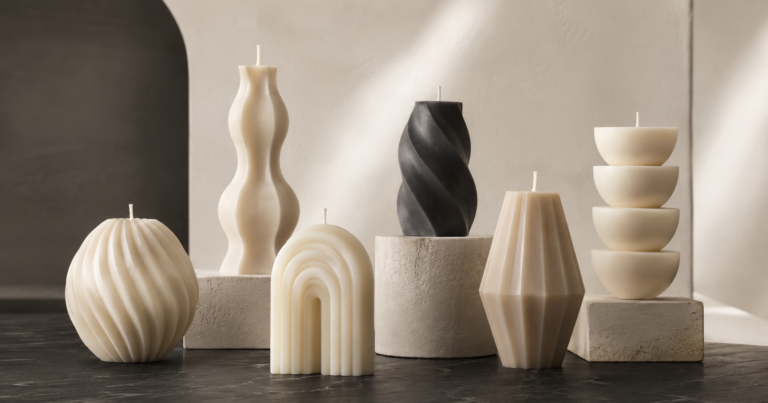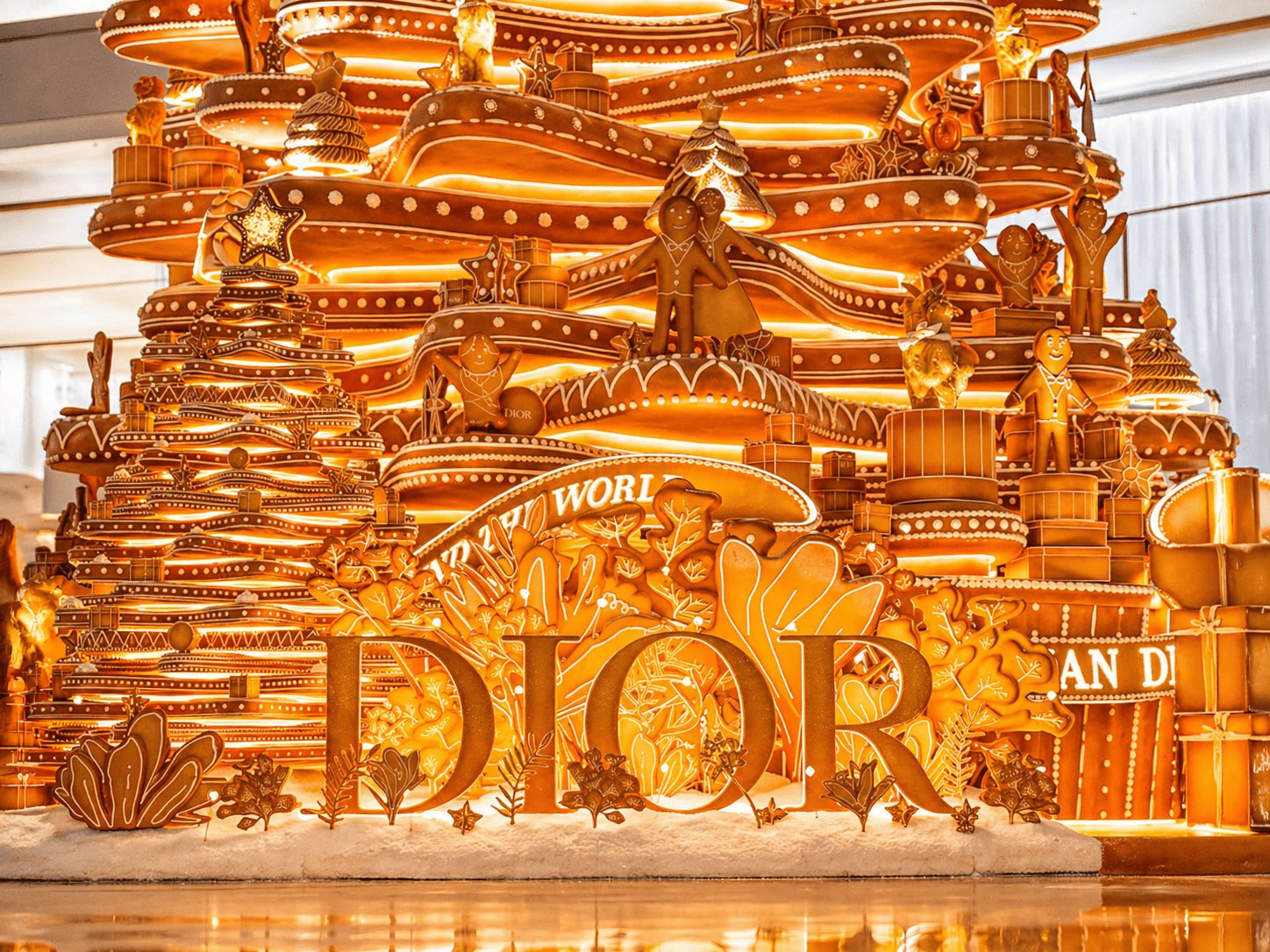

When the Dior Christmas candle project reached our studio, it was an emergency rescue mission. The previous supplier had delivered products plagued by surface flaws, structural instability, and failed color reproduction. For a luxury brand where "good enough" is a disaster, these flaws weren't just technical errors—they were brand-damaging failures.
Many clients assume candle making is a simple craft1, but high-end pieces with complex textures require more than just pouring wax. Without a deep understanding of material shrinkage and mold tension, you end up with "failed works" characterized by broken edges, air bubbles, and a cheap, dull finish.2 These issues often surface too late, threatening global launch deadlines and luxury gifting standards.
As an in-house studio, we don’t just "make" products; we provide end-to-end technical solutions. We took over the Dior project to prove that professional execution requires a seamless link between 3D modeling3, mold engineering4, color systems5, and wax chemistry6. By rebuilding the project from the ground up, we transformed a manufacturing failure into a masterpiece of luxury gifting.
What defines the core capability of high-end candle customization? The success of a premium candle project depends on full-process synergy7, which integrates 3D modeling for production feasibility, mold design for seamless de-molding, standardized Pantone color systems, and wax bases specifically engineered for structural integrity. Professional studios mitigate risks early in the design phase by balancing aesthetic expression with manufacturing logic to ensure a flawless final product.8
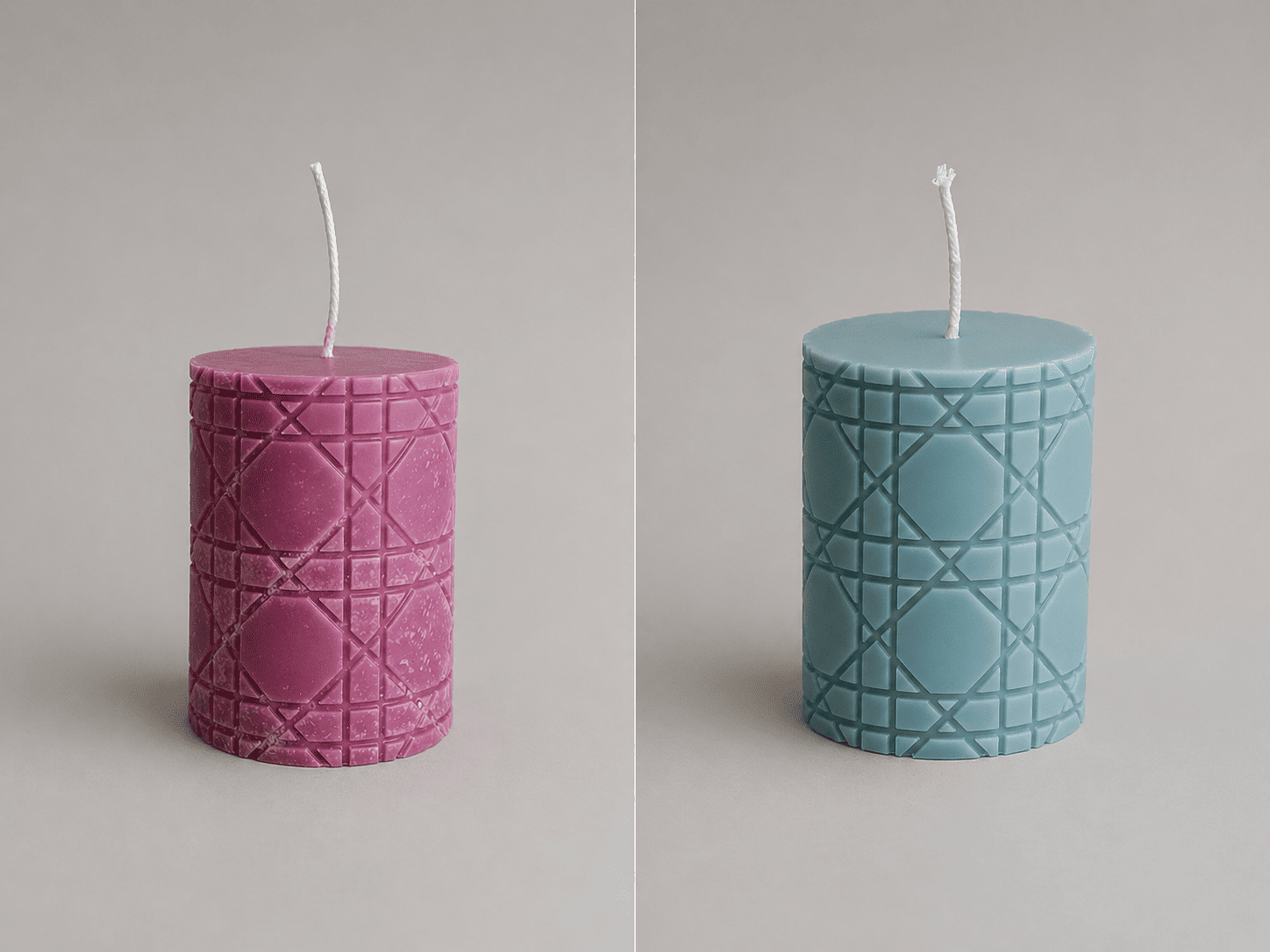
To save this project, we deconstructed the failure into four critical technical pillars. This is how our studio bridges the gap between a creative concept and a luxury reality.
1. 3D Modeling: Validating Production Logic at the Start
Many designers treat 3D modeling as a purely visual task, ignoring how wax actually behaves. In the failed Dior samples, the texture depth was unmanaged—either too shallow to show detail or so deep that the wax snapped during de-molding. When modeling lacks "landing logic9," the most beautiful digital file becomes a nightmare on the factory floor. Every intricate line in the Dior pattern becomes a potential point of fracture if the angles aren't calculated for physical release.10
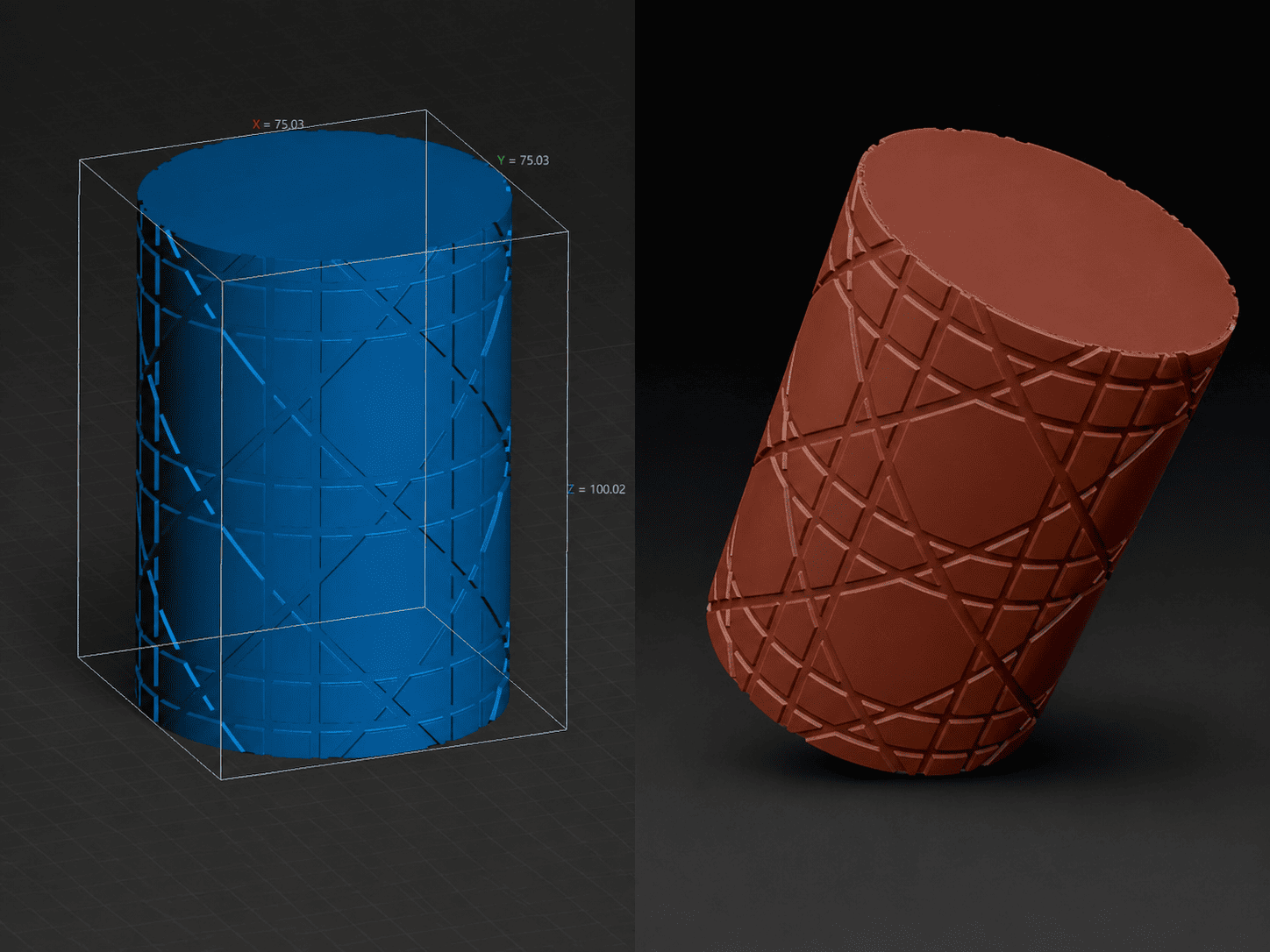
We re-modeled the entire piece with a "production-first" mindset. This meant calculating the exact slope and depth of every texture to ensure the wax could be released without a single scratch.
In high-end candle development, 3D modeling is the foundation of production feasibility. Professional modeling must anticipate de-molding risks, structural strength, and mass-production adaptability.11 By simulating the release path during the digital phase, studios can eliminate fractures and surface defects before a single mold is cast.
Modeling Logic Comparison
| Dimension | General Modeling (Failure) | Our Professional Modeling (Solution) |
|---|---|---|
| Texture Depth | Arbitrary settings leading to breakage | Calculated based on wax shrinkage rates |
| Detailing | Visual focus only, ignoring de-molding | Pre-validated release paths for crisp edges |
| Structural Integrity | No consideration for material strength | Engineered to support complex 3D geometry |
2. Mold Development: Achieving the "Seamless" Luxury Standard
For high-weight, complex candles, the mold is the bottleneck. The initial failed Dior products showed visible seam lines and warping because the molds were either too flimsy to hold the wax's weight or too rigid to release the details.
A cheap mold ruins a luxury design. If the mold structure is poorly planned, you get "mold marks" or collapsed sections that no amount of post-processing can fix.
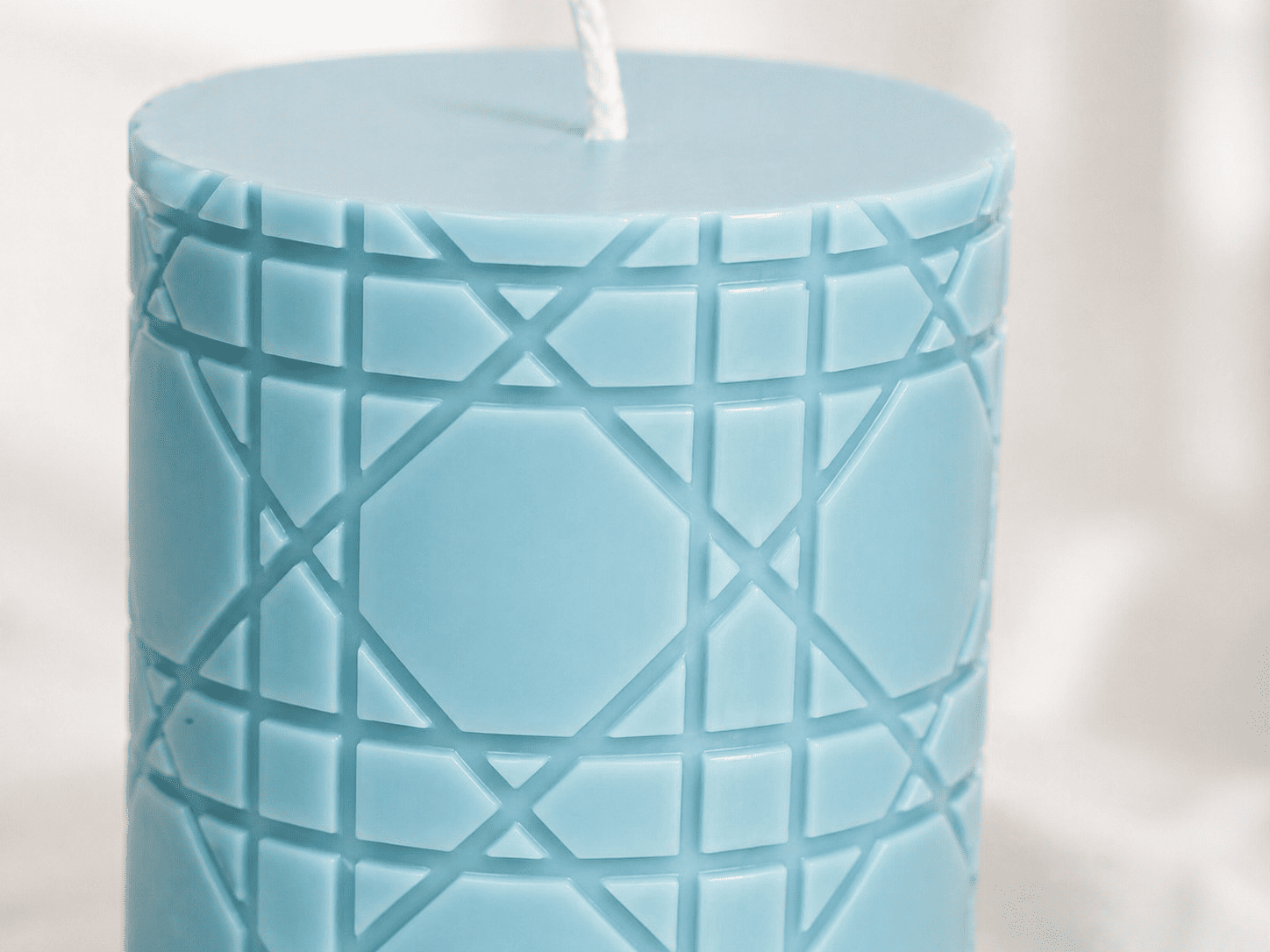
We achieved a "seamless" finish by custom-engineering the mold’s silicone thickness and parting lines. This ensures the candle retains Dior’s iconic silhouette with zero distortion.12
The gold standard for luxury candle molds is "trace-less restoration". This requires meticulous planning of de-molding logic and mold pathing to ensure the final product shows no visible seams or joining marks. Balancing the silicone's thickness and elasticity is a skill driven by experience, preventing the wax from deforming the mold during the cooling process.13
3. Color Systems: Precision Beyond "Close Enough"
Luxury brands like Dior require absolute color fidelity. The previous supplier delivered samples that were dull and inconsistent, failing to capture the vibrancy of the brand’s holiday palette.
Working with oil-based wax dyes is notoriously difficult.14 A "close match" in the liquid state often turns into a muddy, opaque disappointment once the candle sets.
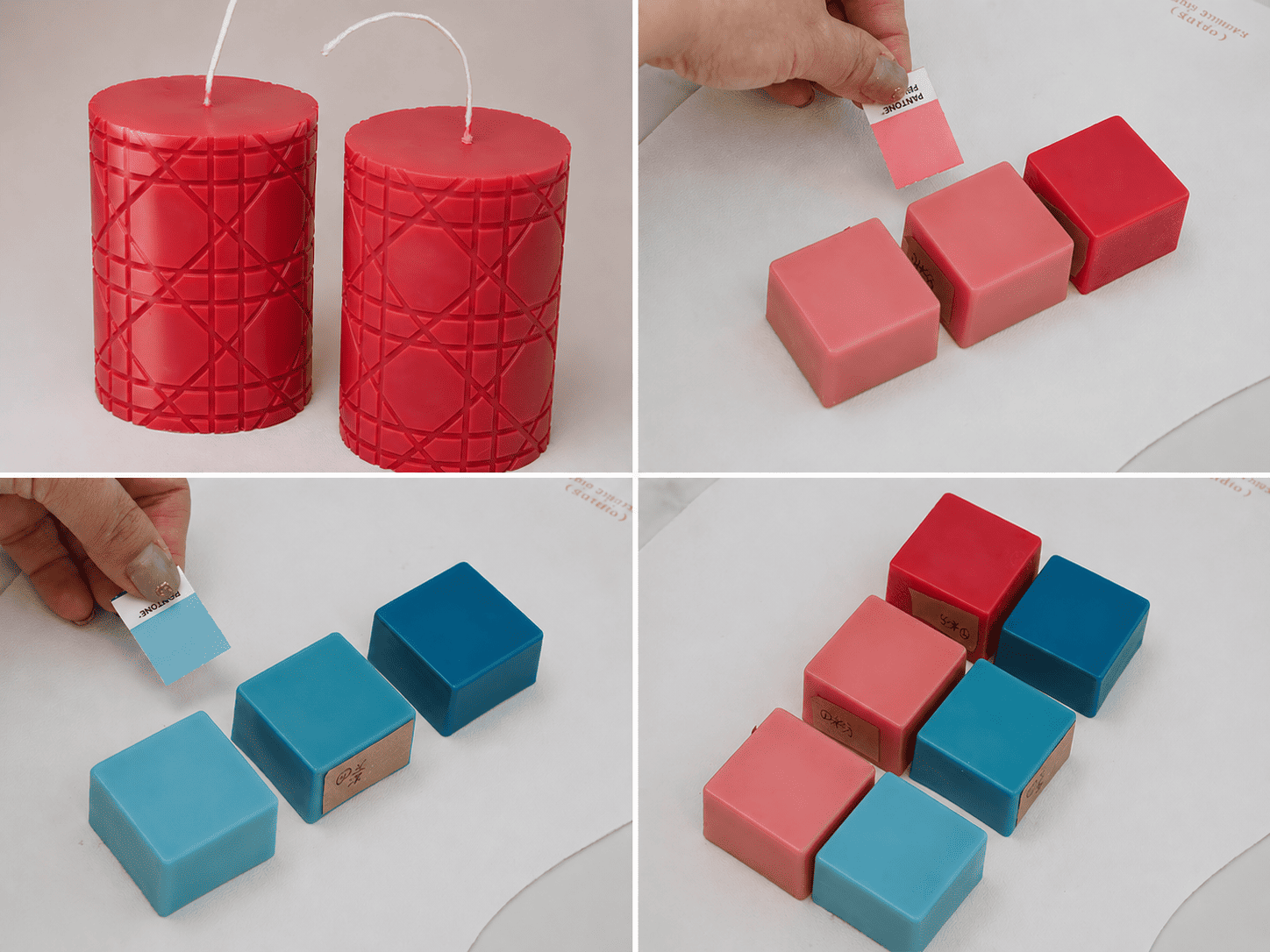
We implemented a standardized Pantone-based color system. By testing the interaction between pigments and our specific wax blend, we achieved a translucent, high-definition color that perfectly matches the brand’s vision.
True luxury color reproduction is a science of material synergy. Utilizing international Pantone standards ensures consistency, but the real expertise lies in managing the wax's oil-based dye system.15To prevent colors from looking "flat" or "dull," the wax base and dye must be calibrated to work together, ensuring the final hue remains vibrant and true to the brand’s identity.
4. Wax Base R&D: The Invisible Support System
Surface frosting, internal bubbles, and structural fragility are symptoms of a poor wax base. In the failed project, the candles were literally falling apart because the wax couldn't support the intricate Dior carvings.
You cannot use a generic wax formula for an artistic masterpiece. Without the right structural strength and cooling properties, the wax will shrink away from the details or trap air, resulting in a hollow, brittle product.
We developed a custom wax base specifically for this project. This proprietary blend provides the high structural tension needed for the Dior pattern while ensuring a smooth, frost-free surface.16
Custom wax base development is the core capability that enables complex designs. A high-end wax base must be engineered for its specific use case—balancing scent throw, color clarity, and structural toughness. By controlling the wax's cooling contraction and flow, a professional studio can eliminate common defects like frosting or air pockets, ensuring the most detailed designs are delivered with total stability.
Final Thoughts: The Value of an In-House Partner
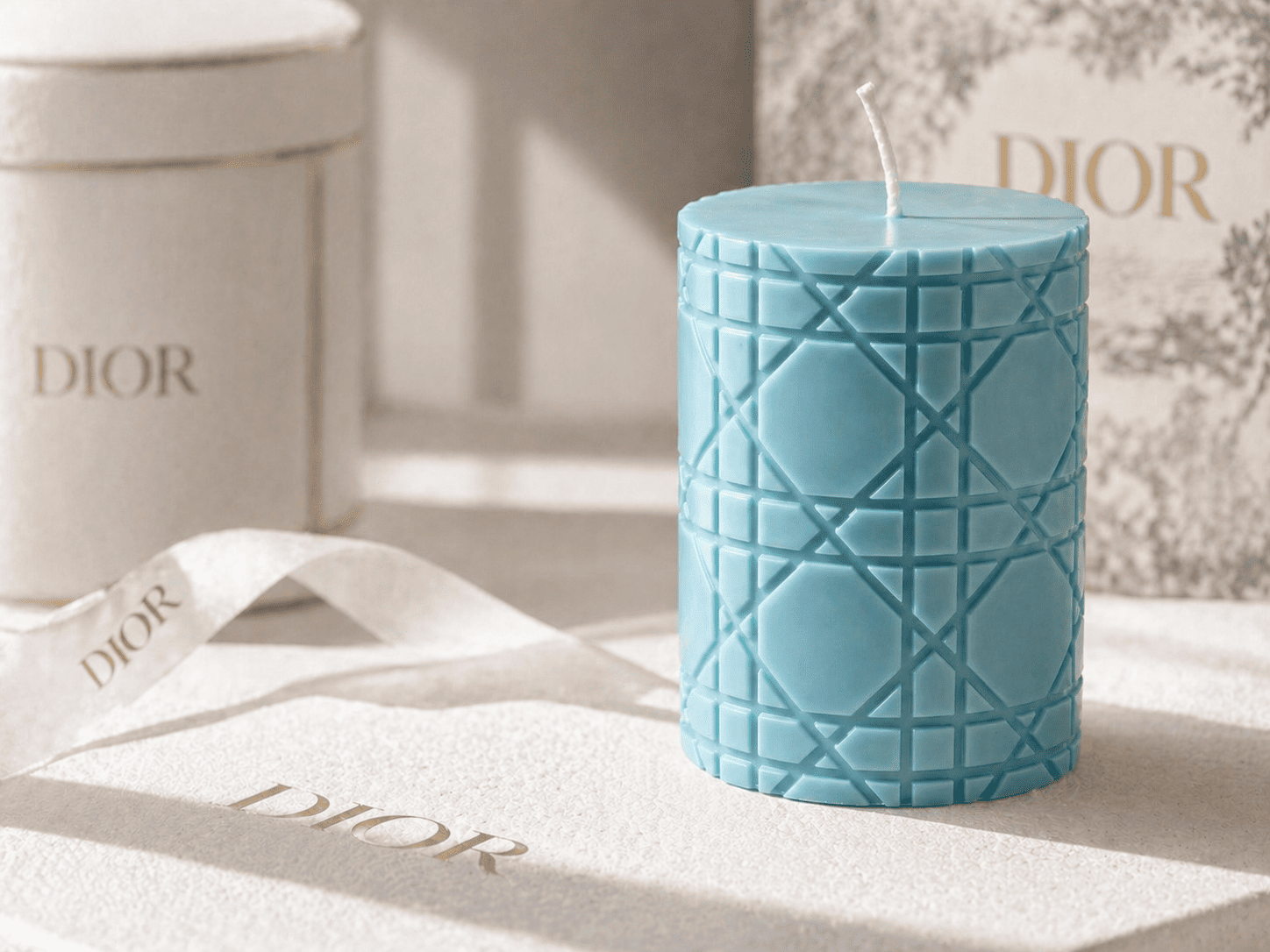
The rescue of the Dior Christmas project proves that high-end manufacturing is about total process control. From 3D modeling to the final wax pour, our studio bridges the gap between "it looks good on paper" and "it is perfect in hand". For brands that cannot afford failure, we are the partner that ensures every detail is preserved.
<!--[googlesitekit-end-of-content]-->
"Effects of Different Mold Materials and Coolant Media on the Cooling ...", https://pmc.ncbi.nlm.nih.gov/articles/PMC8780444/. Academic and industry literature on candle/wax processing emphasizes that high-quality molded candles depend on controllable parameters (wax formulation, cooling rate, mold design, and de-molding conditions), indicating that quality outcomes are not achievable by craft steps alone. Evidence role: general_support; source type: education. Supports: Many clients assume candle making is a simple craft. Scope note: Sources typically describe production variables for molded/quality candles; they may not address “clients” specifically. ↩
"A Molecular Dynamics Investigation of Wax Crystallization in Crude ...", https://pmc.ncbi.nlm.nih.gov/articles/PMC13000615/. Materials science and wax crystallization literature links shrinkage/solidification behavior and mold contact/pressure conditions to defects such as surface roughness, voids/air entrapment, and inconsistent appearance after cooling. Evidence role: mechanism; source type: paper. Supports: Without a deep understanding of material shrinkage and mold tension, you end up with defects like broken edges, air bubbles, and dull finish.. Scope note: The article bundles multiple failure modes and ties them to “mold tension” and shrinkage; external sources may discuss related mechanisms but not in exactly the same terms. ↩
"The Use of Additive Manufacturing Techniques in the Development ...", https://pmc.ncbi.nlm.nih.gov/articles/PMC11054453/. 3D/CAD modeling for manufacturing is commonly used to translate design intent into production-feasible geometries by incorporating manufacturability constraints (e.g., draft/parting considerations and realistic surface detail), which reduces downstream defects during mold-based fabrication. Evidence role: mechanism; source type: research. Supports: In high-end candle development, 3D modeling is the foundation of production feasibility.. Scope note: This supports the general idea that early modeling choices affect manufacturing outcomes (feasibility and defect risk), but it does not specifically address candle wax behavior; candle-specific validation would require additional sources on wax shrinkage, cooling, and demolding. ↩
"[PDF] Plastics: Mold Design and Fabrication - UNI ScholarWorks", https://scholarworks.uni.edu/cgi/viewcontent.cgi?article=3680&context=grp. Molding—especially for casting polymers and related materials—requires engineering the mold geometry, parting lines, and material behavior during cooling to control defects such as warpage, surface blemishes, and release-related marks, which supports the role of “mold engineering” in achieving high-quality cast parts. Evidence role: mechanism; source type: encyclopedia. Supports: “mold engineering”. Scope note: The claim is broadly supported for casting/molding processes; the specific details for candle wax (e.g., exact silicone thickness or de-molding mechanics) may vary by wax formulation and mold material. ↩
"Pantone - Wikipedia", https://en.wikipedia.org/wiki/Pantone. The Pantone Matching System (PMS) is designed to provide a standardized method for selecting and communicating color across different materials and production contexts, supporting consistent color targets for manufacturing workflows. Evidence role: definition; source type: encyclopedia. Supports: color systems. Scope note: This supports standardization of color communication, not specific performance claims about any particular wax dye chemistry or achieving translucency/vibrancy in candles. ↩
"oil wax crystallization: Topics by Science.gov", https://www.science.gov/topicpages/o/oil+wax+crystallization. Wax candles’ physical quality depends on formulation and processing—i.e., the chemistry of the wax blend (composition, crystallization/solidification behavior, viscosity, and interactions with additives/dyes)—which influences shrinkage, surface appearance (e.g., frosting), and defect formation such as voids/bubbles. Evidence role: mechanism; source type: research. Supports: wax chemistry. Scope note: The specific interactions can vary by wax type (paraffin, soy, beeswax, blends), additives, and cooling conditions; sources typically describe general principles rather than the article’s proprietary formulation details. ↩
"[PDF] Defense-Manufacturing-Management-Guide-for-PMs.pdf", https://www.waru.edu/sites/default/files/Migrated/ToolAttachments/Defense-Manufacturing-Management-Guide-for-PMs.pdf. Research on product development and manufacturing emphasizes that integrating design, process planning, materials selection, and downstream constraints early in development reduces defects and improves manufacturability, quality, and consistency—supporting the idea of end-to-end “full-process” coordination. Evidence role: general_support; source type: research. Supports: full-process synergy. Scope note: May not be specific to candles or Pantone/wax dye workflows; it supports the broader principle of integrated product–process–materials planning. ↩
"[PDF] Product Development Risk Management and the ... - DSpace@MIT", http://dspace.mit.edu/bitstream/handle/1721.1/74936/815958097-MIT.pdf?sequence=2&isAllowed=y. Best practices in product development (e.g., design for manufacturing/DFM and risk reduction via early engineering validation) support the general claim that anticipating manufacturability in early design reduces downstream defects. Evidence role: expert_consensus; source type: encyclopedia. Supports: Professional studios mitigate risks early by balancing design aesthetics with manufacturing logic to prevent defects.. Scope note: The sources may support the general engineering principle, not “flawless final product” specifically for candle manufacturing. ↩
"Understanding Parting Lines in Injection Molding - Protolabs", https://www.protolabs.com/resources/design-tips/planning-for-parting-lines-in-injection-molding/. In polymer/thermoplastic and composite manufacturing, “parting lines,” “draft,” and other mold-design measures (often informed by shrinkage and release-path considerations) are used to ensure parts can be demolded without damage and to prevent surface defects caused by geometry interacting with material contraction and mold contact. Evidence role: mechanism; source type: encyclopedia. Supports: landing logic. Scope note: This is generalizable manufacturing-molding evidence; it does not specifically study luxury candles or wax, but the release/shrinkage/demolding logic is analogous to candle wax demolding problems. ↩
"Investigation and Improvement Strategies for Mold Fracture - PMC", https://pmc.ncbi.nlm.nih.gov/articles/PMC10707277/. Molding and de-molding engineering references explain that undercuts, insufficient draft angles, and geometry incompatible with demolding increase the likelihood of cracking, chipping, and surface damage during release. Evidence role: mechanism; source type: education. Supports: Intricate geometry can fracture during de-molding if angles/draft are not calculated for physical release.. Scope note: Support will likely be for plastics/resins or general molding; candle-specific confirmation may require bridging from general demolding physics. ↩
"[PDF] Design Principles of Scalable Reconfigurable Manufacturing Systems", https://ykoren.engin.umich.edu/wp-content/uploads/sites/122/2013/09/St-Petersburgh-IFAC-MIM13_0185.pdf. Manufacturing engineering guidance on moldability and design for manufacturing includes anticipating demolding constraints and load-bearing/structural considerations to reduce failures during production and scaling. Evidence role: general_support; source type: government. Supports: Professional modeling should anticipate demolding risks, structural strength, and scalability constraints.. Scope note: The citations may be generic to product/mold design, not explicitly “candles,” and may not cover “mass-production adaptability” in candle terms. ↩
"Increasing Silicone Mold Longevity: A Review of Surface ...", https://pmc.ncbi.nlm.nih.gov/articles/PMC8758012/. Mold/material literature indicates that elastomer thickness, parting line placement, and compliance influence shrinkage accommodation and surface fidelity, affecting distortion and visible seams. Evidence role: mechanism; source type: research. Supports: Custom mold elastomer thickness and parting-line engineering can reduce visible seams and distortion in molded products.. Scope note: The sources can support the general relationship between mold parameters and appearance/distortion; they likely cannot confirm Dior-specific outcomes or “zero distortion.” ↩
"Experimental Study on Warpage Phenomenon of Wax Parts ...", https://pmc.ncbi.nlm.nih.gov/articles/PMC10819220/. Heat transfer and solidification engineering describes how cooling rate, wax shrinkage, and mold compliance can interact during setting, influencing warpage or surface defects; elastomer modulus/compliance can affect demolding and fidelity. Evidence role: mechanism; source type: paper. Supports: Silicone thickness/modulus influences how wax deformation during cooling impacts mold fidelity.. Scope note: Support will likely be general to polymer/phase-change molding; it may not directly quantify wax–silicone interactions in candles. ↩
"A Molecular Dynamics Investigation of Wax Crystallization in Crude ...", https://pmc.ncbi.nlm.nih.gov/articles/PMC13000615/. Dye compatibility and dispersion literature for waxes/paraffin (including issues like solubility, phase separation, and color consistency) can substantiate that achieving uniform coloration in wax can be technically challenging. Evidence role: general_support; source type: research. Supports: Oil-based wax dyes/pigment systems can be difficult to process consistently in candles.. Scope note: “Oil-based” may vary by product chemistry; sources may cover general pigment dispersion and compatibility rather than exactly “oil-based wax dyes.” ↩
"[PDF] OPTICAL PROPERTIES OF PAPER: THEORY AND PRACTICE", https://bioresources.cnr.ncsu.edu/wp-content/uploads/2019/04/2009.1.273.pdf. Colorimetry and standards literature indicates that Pantone/standardized color references support communication and repeatability, while final appearance depends on substrate/material effects (optical properties) and formulation, meaning standards alone do not guarantee identical results across materials. Evidence role: mechanism; source type: encyclopedia. Supports: Pantone standards help with consistency, but final color depends on dye–wax interactions and formulation.. Scope note: Sources support the general principle that material/color interactions matter; they may not directly address candles and Pantone together. ↩
"Apple-like Shape of Freezing Paraffin Wax Droplets and Its Origin", https://pmc.ncbi.nlm.nih.gov/articles/PMC10456291/. Wax crystallization/phase behavior literature explains that formulation and cooling conditions influence frosting and mechanical integrity (brittleness/voids), so tailored blends can reduce surface bloom and improve structural stability—though “high structural tension” is a colloquial term not always used in the literature. Evidence role: mechanism; source type: paper. Supports: Tailoring wax formulation can improve structural stability and reduce frosting/rough surface appearance in molded candles.. Scope note: The citation may support general formulation–frosting/mechanical behavior links, but not validate Dior-specific performance or the exact phrase “structural tension.” ↩