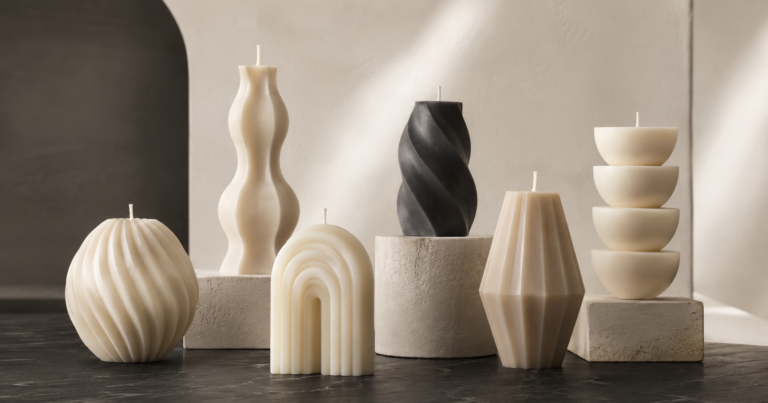

Choosing a wax too early can lock a bespoke candle into the wrong structure, finish, fragrance performance, or production method before development even begins.
The right wax system starts with the finished product. Define the geometry, surface, fragrance, burn behavior, shipping conditions, and production needs first. Then select and validate the wax grade, additives, wick, process, and packaging as one system.

When a brand sends us a candle concept, I do not want the first question to be, “Should we use soy wax or paraffin?” That question comes too early. I first want to understand what the finished object needs to do.
1. Why Is “Soy or Paraffin?” the Wrong First Question?
Wax labels sound simple. The problem is that they hide large differences between grades, formulas, and applications.
Soy, paraffin, coconut, palm, and beeswax are material families, not finished-product specifications.1 Each family contains different grades with different hardness, melting behavior, fragrance capacity, appearance, and intended applications. A buyer should first define the product requirements, then screen specific grades.
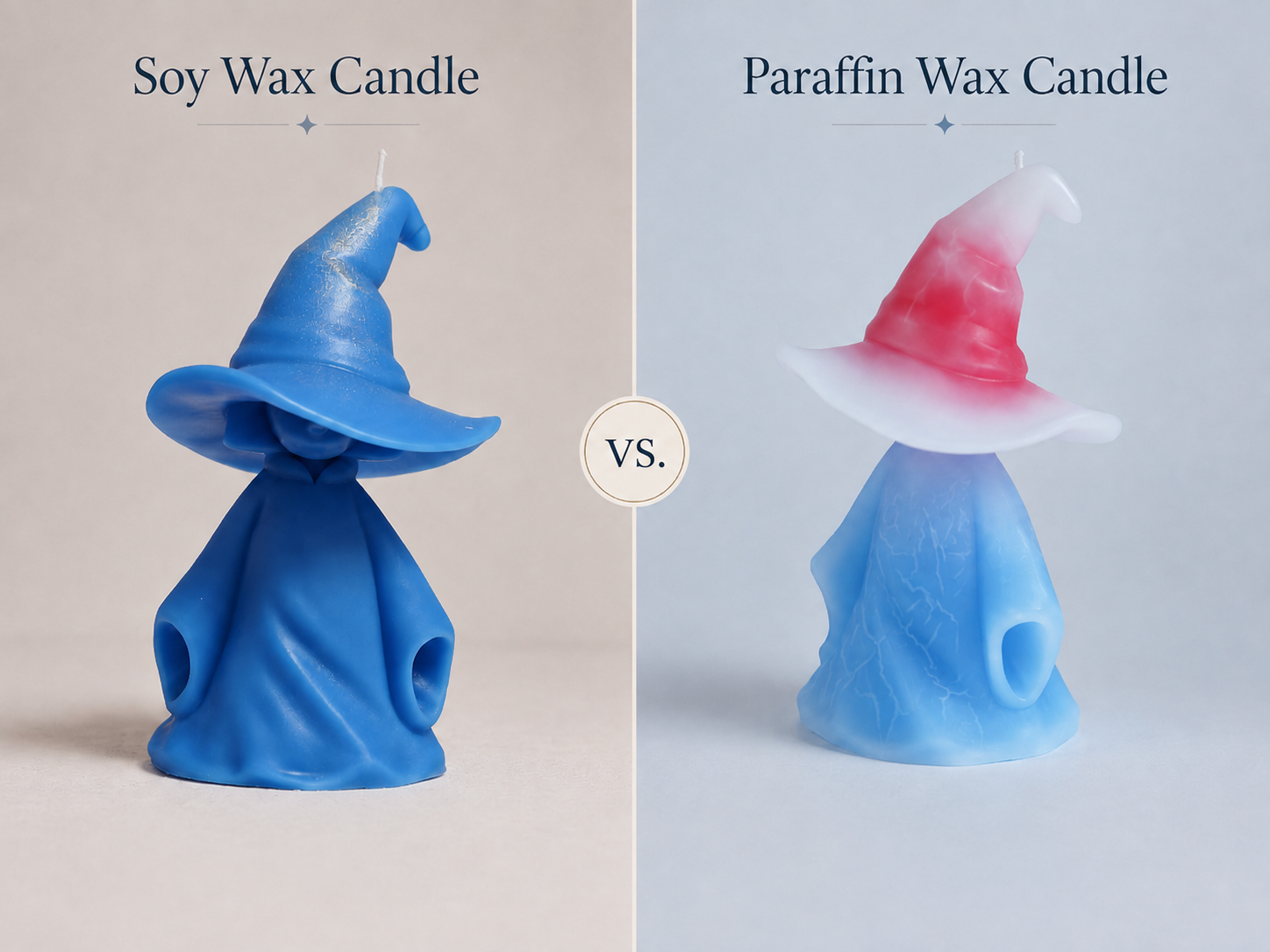
A Wax Family Does Not Tell You Enough
One of the most useful lessons from wax development is that a family name tells us much less than buyers often expect.
A supplier may sell several products under the name “soy wax,” but some are designed for containers while others are suitable for molded products. The same issue exists with paraffin. Fully refined and semi-refined grades can have different oil content, hardness, and melting behavior.2 Research across supplier portfolios also shows that grades inside the same family can have very different stated applications.
This is why I prefer to separate marketing language from engineering specification.
| Buyer asks | Development team should ask |
|---|---|
| Is soy better? | Which soy grade is suitable for this geometry? |
| Is paraffin cheaper? | Which grade gives the required structure and finish? |
| Is natural wax cleaner? | What evidence supports the finished-product claim? |
| Can we use coconut wax? | Is it a base wax or only a softening component? |
A wax family is a starting category. The real decision begins at the grade and formulation level.
2. Can the Wax System Support the Candle Geometry?
A beautiful wax formula has little value if the finished candle bends, cracks, shrinks, chips, or loses the intended shape.
For freestanding candles, geometry should be one of the first engineering filters. Height, diameter, thin sections, undercuts, narrow bases, relief details, and asymmetric forms change the structural demands placed on the wax system.

Geometry Changes the Material Requirement
A container candle has external support. A sculptural candle does not.3
That difference becomes important when a design has a long unsupported section, a narrow connection point, a deep relief pattern, or a large difference in wall thickness. The wax must survive demolding, handling, storage, and shipping before anyone even lights the wick.
This is where I often see the gap between a 3D concept and manufacturing reality. A shape can look simple on screen but create difficult shrinkage, cooling, or release behavior in a mold.
Supplier guidance also reflects this. Wax grades and additives are often separated by application.4 Some systems are designed for containers, while others are intended for pillars, tapers, molded candles, or other freestanding formats. Additive recommendations can also change with wax melting point and geometry.
| Geometry feature | Development concern |
|---|---|
| Tall taper | Bending and transport stability |
| Thin projection | Breakage and incomplete filling |
| Deep relief | Mold release and detail reproduction |
| Wide pillar | Shrinkage and sink marks |
| Narrow base | Structural stability |
| Asymmetric form | Uneven cooling and burn behavior |
The design brief should therefore come before the final wax specification.
3. What Surface Should the Finished Candle Have?
A premium candle is judged before it is burned. Surface quality, color, texture, and consistency can decide whether the product feels premium or unfinished.
Matte, satin, glossy, creamy, translucent, crystalline, and stone-like finishes are not controlled by wax family alone. Wax grade, additives, pigment, pouring temperature, cooling conditions, and geometry can all change the final surface.5

Surface Finish Is a Manufactured Result
Buyers often give us a Pantone color and a reference image. That is useful, but it does not fully define the finish.
Two candles can match the same basic color and still look very different. One may be highly glossy. Another may be soft and matte. One may look dense and opaque. Another may show slight translucency.
In one CandleScience lab test on a specific paraffin pillar wax, different pouring temperatures produced different surface results. Pouring at higher temperatures gave a smoother and shinier finish, while lower temperatures produced jump lines and mixed matte and glossy areas. This result applies to that specific wax and test setup, so it should not be treated as a universal rule. It still shows why processing conditions cannot be separated from formulation.
At ZLCandle, I prefer to define surface language during development and approve it against a physical reference.
| Design target | Variables to control |
|---|---|
| Matte | Wax structure, cooling, additives |
| Glossy | Formula, mold surface, pouring conditions |
| Opaque | Wax grade, additives, pigment |
| Translucent | Wax structure and color system |
| Crystalline | Grade selection and cooling behavior |
| Consistent color | Pigment dispersion and process control |
For premium products, the approved sample becomes more useful than a material label alone.
4. How Should Fragrance Be Built Into the Wax System?
Adding more fragrance sounds like an easy way to create a stronger candle. In practice, higher fragrance load can create new problems.
Fragrance load is specific to the wax grade and formulation. More oil does not guarantee stronger scent. Excess fragrance can cause separation and can affect stability and burn behavior6, so the final wax-fragrance combination must be tested together.
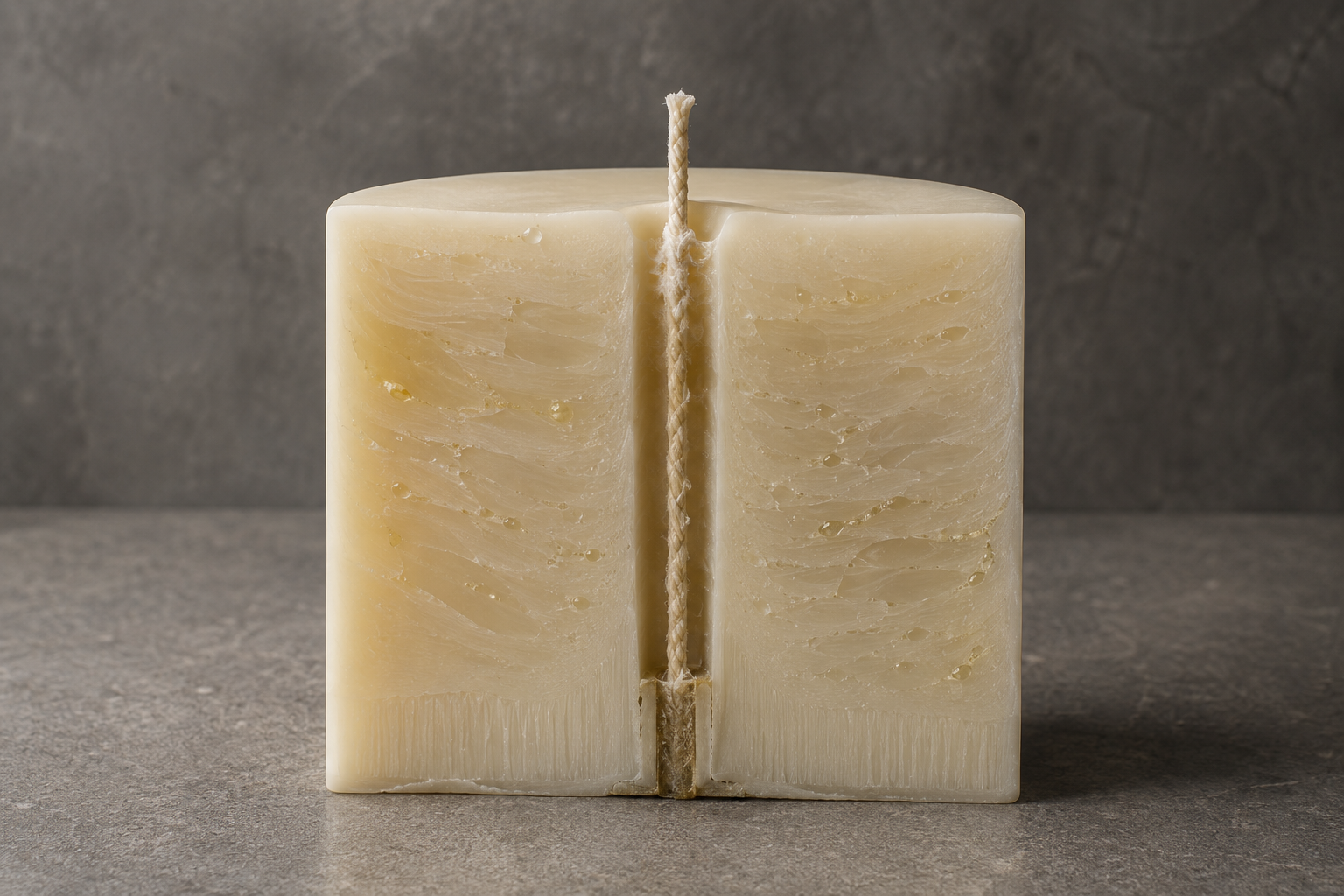
Fragrance Is a Material Variable
I do not treat fragrance as something that is simply added after the wax formula has been selected.
The fragrance oil changes the system.
Supplier guidance in the research shows that recommended fragrance loads vary between wax types and between individual products. IGI, for example, lists different fragrance capacities for different SKUs. Cargill also provides different recommended ranges across paraffin, soy, beeswax, rapeseed, and coconut systems. These numbers are guidance, not universal limits.
This creates an important buyer decision.
| Buyer goal | What must be checked |
|---|---|
| Strong hot throw | Formula, wick, load, cure behavior |
| High fragrance percentage | Separation and stability |
| Dark pigment + fragrance | Burn and color interaction |
| Long storage | Sweating, migration, scent stability |
| Premium surface | Oil migration and surface change |
Cargill also warns that excessive fragrance can cause separation and fire hazards.7 This is why “10% fragrance” or “12% fragrance” should never be treated as a quality grade on its own.
The useful question is not “How much fragrance can we add?” It is “What fragrance performance can this finished candle deliver reliably?”
5. Why Must the Wick and Burn Be Tested on the Finished Candle?
A correct wax and a good fragrance do not automatically create a good burn. The wick interacts with every part of the system.
Wick choice should be validated on the actual fragranced, colored, cured candle in its final geometry.8 Raw-material documents and wick charts provide useful starting information, but they cannot replace finished-product burn testing.
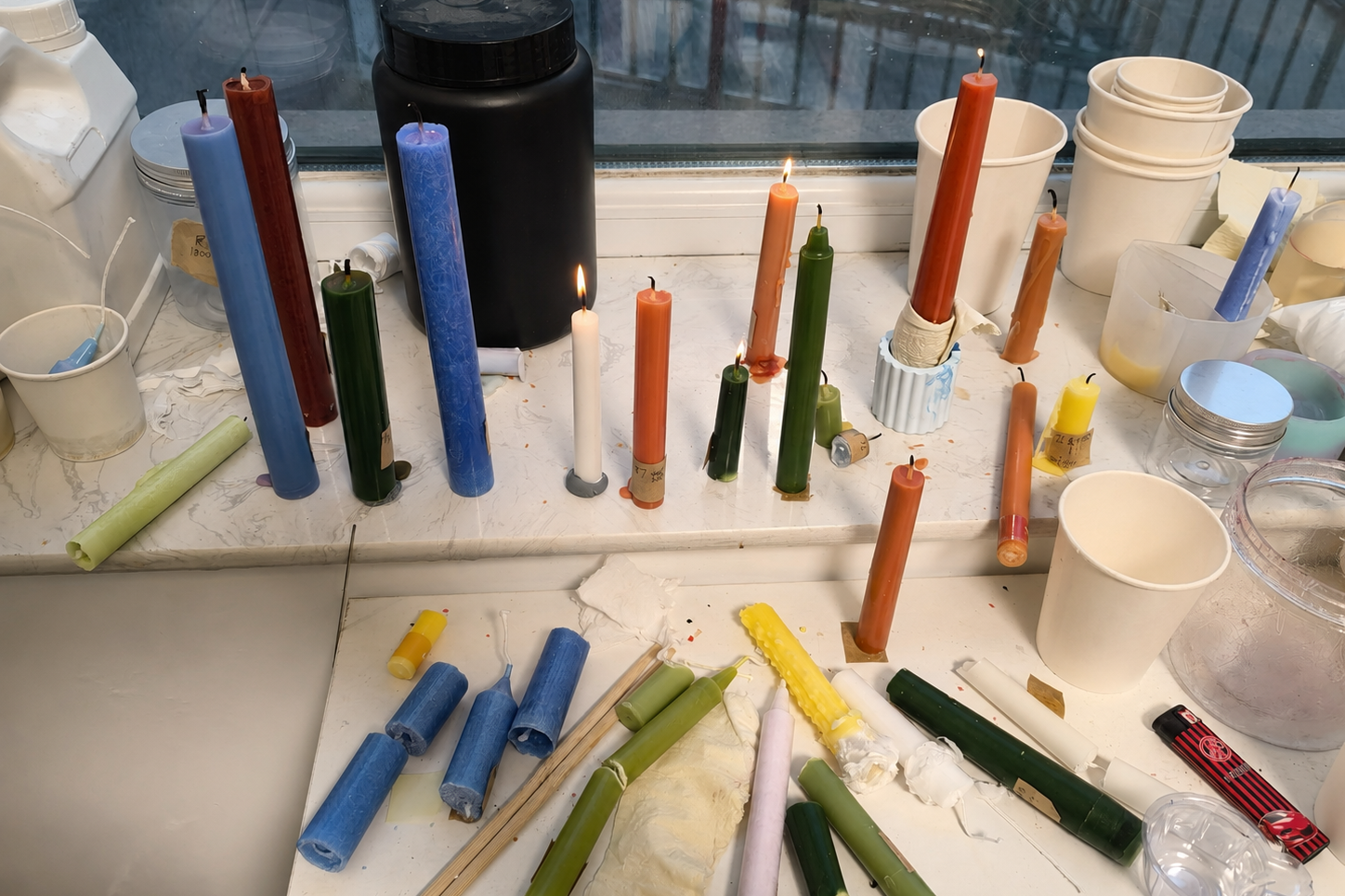
Documentation and Product Validation Are Different
This distinction matters for sourcing teams because compliance documents can create false confidence.
An IFRA Certificate of Conformity has a defined purpose. The research notes that IFRA itself states that the certificate does not replace a safety assessment and that IFRA does not certify finished products.9 The research also warns that there is no single official document that directly says an IFRA certificate is proof or non-proof of finished-candle fire safety. That conclusion comes from comparing the narrower scopes of the relevant systems.
For development work, I use a simpler distinction:
| Document or test | What it helps answer |
|---|---|
| Wax TDS | What are the stated properties of this material? |
| IFRA documentation | Does the fragrance mixture meet the relevant ingredient-use framework? |
| Wick guidance | Where should wick testing begin? |
| Finished burn test | How does this candle actually burn? |
The final test must include the real wax, fragrance, pigment, wick, and geometry. A change in any one of these variables can change flame behavior, melt behavior, soot, dripping, or structural performance.10
6. Can the Wax System Survive Storage and International Shipping?
A candle can burn perfectly in the development room and still fail before it reaches the customer.
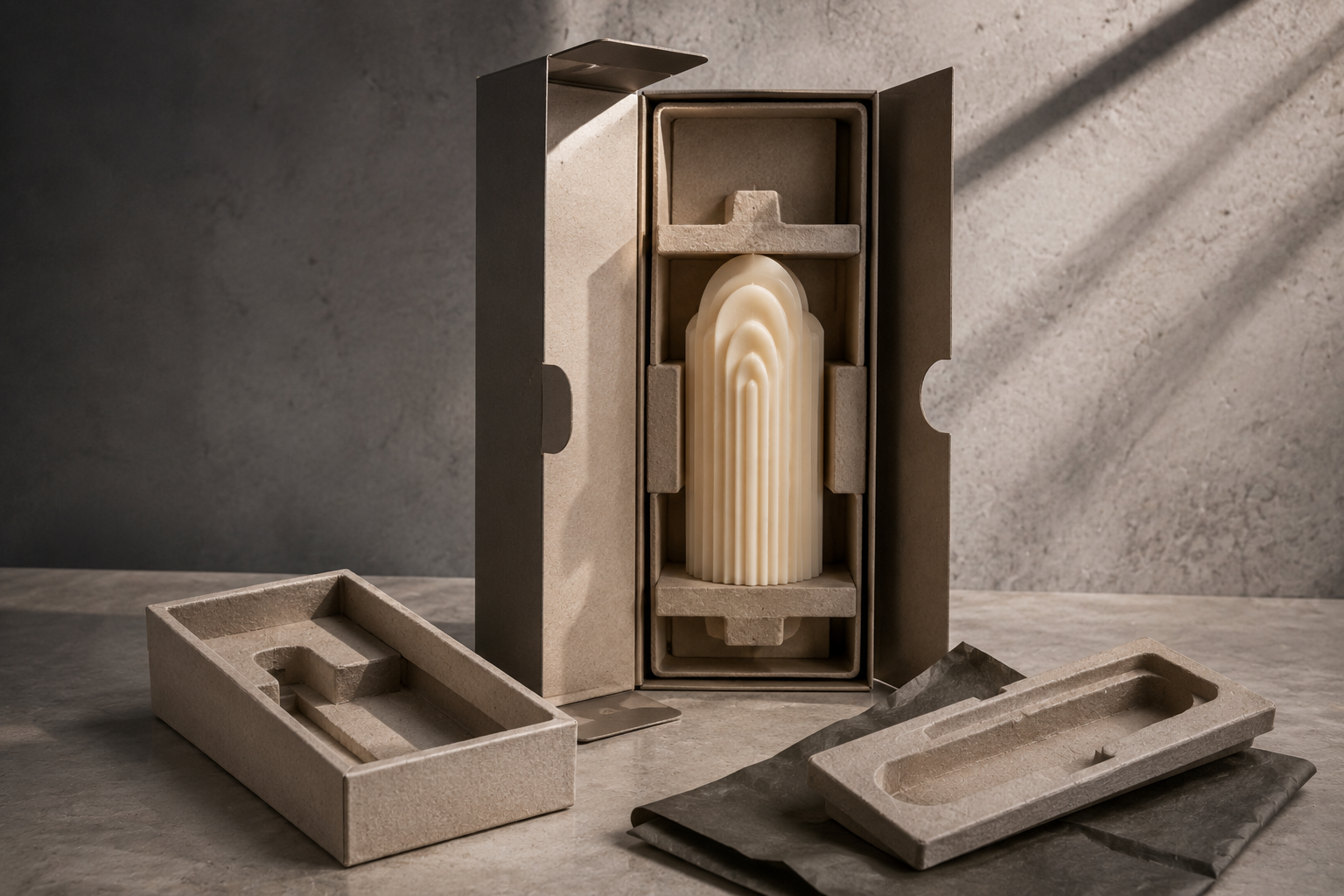
Melting point alone is not a complete shipping specification.11 Finished candles also face heat exposure, vibration, compression, bending, surface contact, and changing storage conditions during distribution.
Test the Product and Packaging Together
This matters most for freestanding products.
A tall taper can bend without melting. A sculptural candle can lose a delicate projection after repeated vibration. A polished surface can become marked by packaging material. A fragranced formula can also behave differently after long storage in warm conditions.
The research found no public universal candle-specific transport temperature specification. It also found that wax suppliers often publish melting or dropping points separately from storage guidance. These are different pieces of information.
For this reason, I prefer to treat shipping as a product-plus-packaging engineering problem.
| Distribution risk | What should be validated |
|---|---|
| Heat | Shape and surface stability |
| Compression | Structural damage |
| Vibration | Cracking and abrasion |
| Long transit | Fragrance and surface stability |
| Packaging contact | Marks, sticking, migration |
| Seasonal routes | Temperature exposure |
The shipping lane also matters. A product going through a hot summer logistics network may need different validation from the same candle sold locally in a controlled environment.
7. Is a Good Prototype Ready for Production?
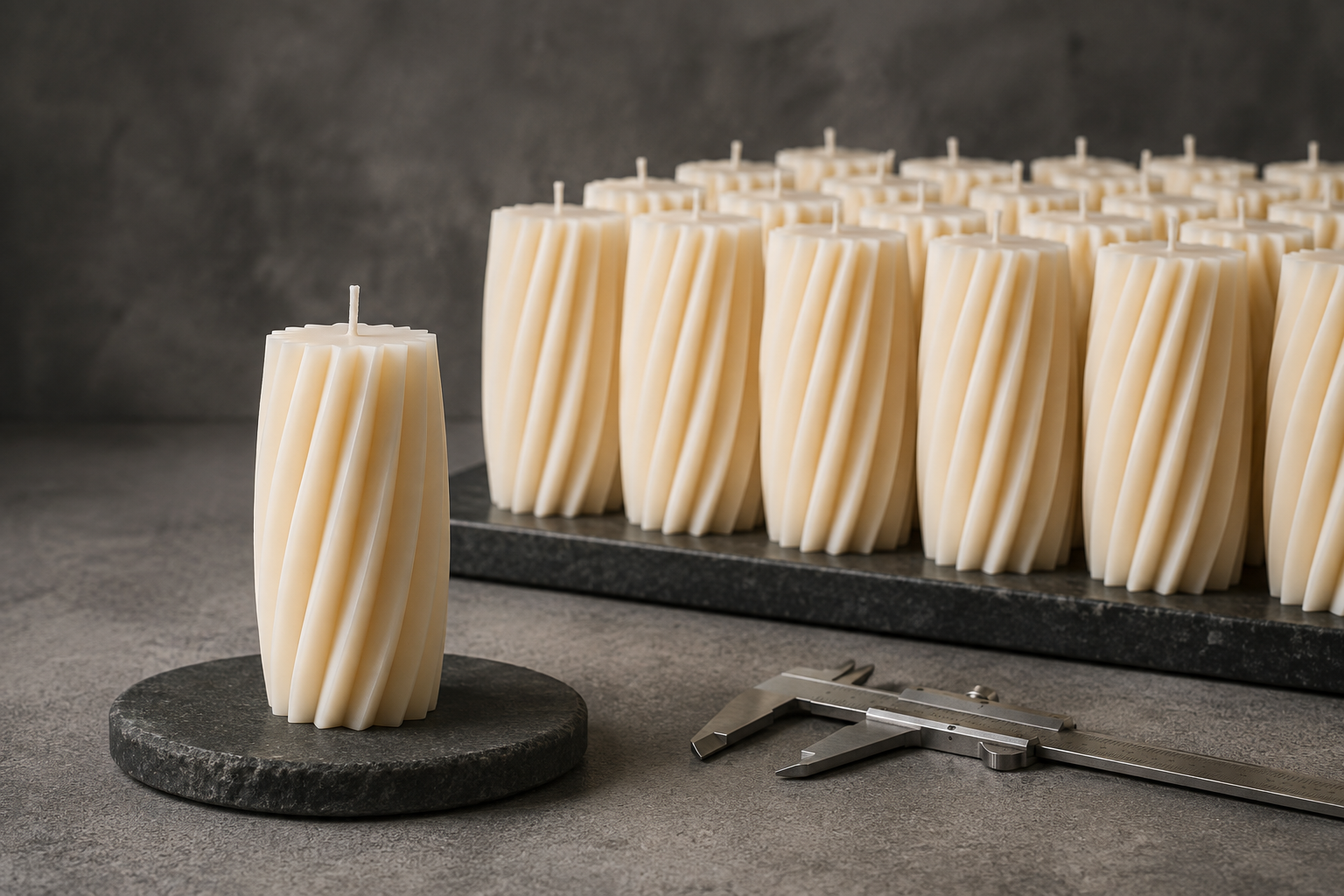
A beautiful prototype proves that the product can be made once. It does not prove that hundreds or thousands can be made consistently.12
Production introduces new variables. Batch size, cooling conditions, labor, yield, scrap, material supply, packaging speed, and batch-to-batch variation can expose problems that never appeared during sampling.
Possibility and Repeatability Are Different Problems
This is one of the most important lessons I have learned from custom product development.
A prototype team can spend extra time correcting one candle. Production cannot depend on unlimited correction.
A sculptural piece may need manual surface work during sampling. That may be acceptable for ten pieces but not for ten thousand. A wax system may also work in a small mold run but behave differently when production conditions change.
The research therefore separates sampling from scale-up and production approval. It recommends confirming supplier MOQ, lead time, batch consistency, appearance, and burn performance at production scale before final approval.
| Prototype question | Production question |
|---|---|
| Can we make it? | Can we repeat it? |
| Does this sample look right? | Will the batch stay within tolerance? |
| Can we correct defects manually? | What is the actual rework rate? |
| Does it burn once? | Is burn behavior consistent across production? |
| Is the material available now? | Is supply reliable at order volume? |
For a premium brand, production consistency is part of the product design.
8. What Exactly Should Be Approved as the Wax Specification?
If the approved sample depends on ten connected variables, approving only the wax name leaves too much room for change.
The approved unit should be the complete wax system: specific wax grade or blend, additives, fragrance, pigment, wick, process conditions, geometry, and packaging. Key substitutions should trigger review and, when needed, re-testing.

Lock the System, Not Just the Ingredient
Imagine that a sample is approved with one wax grade and one fragrance oil.
Production starts three months later. The supplier changes the wax to another grade in the same family because it looks similar on paper.
Is it the same candle?
From a purchasing point of view, the raw material name may look almost unchanged. From an engineering point of view, the system has changed.
The research recommends formal change control because supplier portfolios show large variation even within the same wax family. It also proposes locking the grade, additive percentages, fragrance and pigment identities and loads, wick, process parameters, and packaging as one approved specification.
| System variable | Possible effect of change |
|---|---|
| Wax grade | Hardness, shrinkage, burn, finish |
| Additive | Structure, opacity, release |
| Fragrance | Stability, scent, burn |
| Pigment | Appearance and wick behavior |
| Wick | Flame and melt behavior |
| Cooling process | Surface and shrinkage |
| Mold | Geometry and surface |
| Packaging | Transit stability |
This is why our development work treats the approved candle as a system rather than a list of raw materials.
9. What Is the Buyer’s Decision Framework for Choosing a Wax System?
The buyer does not need to become a wax chemist. The buyer needs a clear sequence for making and approving the right decisions.
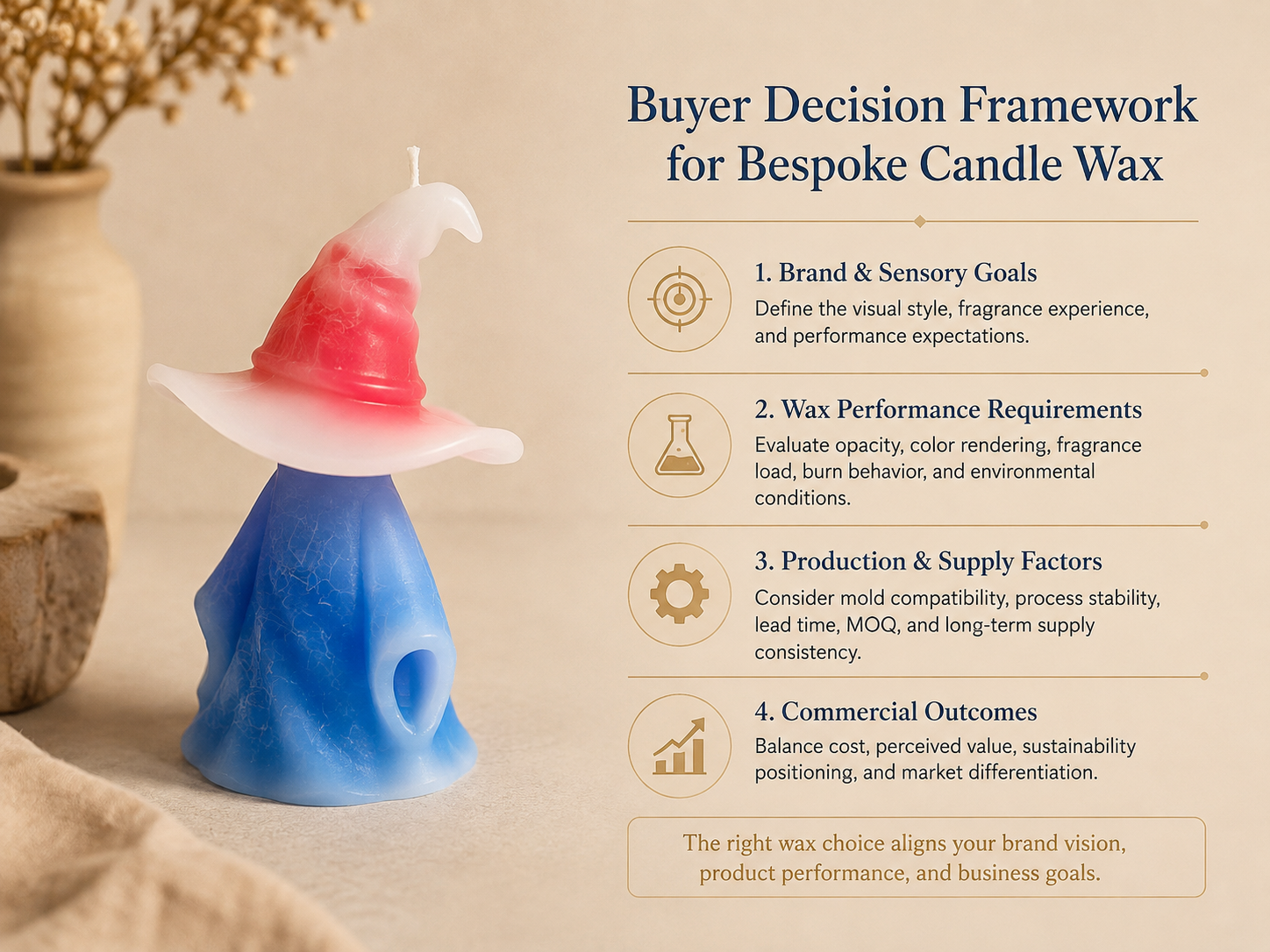
Start with the product brief. Then screen suitable wax grades, build real samples, test the complete candle, validate packaging, confirm production repeatability, and lock the final system before scale-up.
Start With the Product You Want to Sell
When I review a new bespoke candle project, I want the creative brief to stay important. Engineering should support the concept, not replace it.
But the brief needs to become measurable decisions.
The research proposes a buyer input process that includes geometry, target market, surface language, fragrance goals, color consistency, burn priorities, marketing claims, packaging, shipping conditions, and expected production volume.
A practical decision path looks like this:
| Stage | Buyer decision |
|---|---|
| 1. Product intent | What should the candle look, feel, smell, and do? |
| 2. Geometry | What structural demands does the design create? |
| 3. Surface | What finish and color language is required? |
| 4. Fragrance | What scent performance is required? |
| 5. Burn | What burn behavior must be validated? |
| 6. Distribution | Where and how will the product travel? |
| 7. Volume | What must work at production scale? |
| 8. Wax system | Which specific formulation can meet these needs? |
| 9. Prototype | Does the real product meet the brief? |
| 10. Validation | Does it survive burn, storage, and transport testing? |
| 11. Production approval | Can the same result be repeated at scale? |
| 12. Change control | Which changes require re-validation? |
This order changes the role of wax selection. The wax is no longer the starting point. It becomes one engineered part of the finished product.
Conclusion
The best wax is not the one with the strongest label. It is the wax system that can repeatedly deliver the product your brand designed.
"Effect of Different Additives on Burning Efficiency of the ...", https://www.academia.edu/26561234/Effect_of_Different_Additives_on_Burning_Efficiency_of_the_Candles. Technical literature on candle waxes distinguishes broad feedstock categories from the formulated wax blends and performance specifications used in finished candles. Evidence role: definition; source type: paper. Supports: Soy, paraffin, coconut, palm, and beeswax are material families rather than finished-product specifications.. Scope note: Terminology and formulation practices vary among suppliers and candle applications. ↩
""Waxes," in: Ullmann's Encyclopedia of Industrial Chemistry", https://ptacts.uspto.gov/ptacts/public-informations/petitions/1486854/download-documents?artifactId=el57o6C4rTi4ndAAqNjN5c5CwBByVY2PzU4oSoYZFdv1CsS3ShZg6Fk. Petroleum-wax technical references describe fully refined and semi-refined paraffin waxes as differing in residual oil content and associated physical properties, including melting range and hardness. Evidence role: mechanism; source type: institution. Supports: Fully refined and semi-refined paraffin grades can differ in oil content, hardness, and melting behavior.. Scope note: The magnitude of these differences depends on the particular petroleum feedstock and product specification. ↩
"Mechanics of Materials: Axial Load | Mechanics of Slender ...", https://www.bu.edu/moss/mechanics-of-materials-axial-load/. Engineering principles of structural support establish that an unsupported body must resist its own deformation and handling loads, whereas a surrounding container can provide external mechanical constraint. Evidence role: mechanism; source type: education. Supports: Freestanding sculptural candles face structural demands that container candles may not because they lack external support.. Scope note: A container does not necessarily prevent all cracking, shrinkage, or deformation of the wax. ↩
"Soy candle", https://en.wikipedia.org/wiki/Soy_candle. Candle-material technical documentation commonly specifies distinct wax and additive products for container, pillar, taper, and molded applications, reflecting different performance requirements. Evidence role: general_support; source type: institution. Supports: Wax grades and additives are often differentiated by intended candle application.. Scope note: Product categories and recommended applications are manufacturer-specific rather than universal standards. ↩
"Design of Crystal Growth Dimensionality in Synthetic Wax - PMC", https://pmc.ncbi.nlm.nih.gov/articles/PMC10578349/. Studies of wax crystallization and casting show that composition, colorants, mold geometry, thermal history, and cooling rate influence crystal structure, shrinkage, and the visible surface of wax-based products. Evidence role: mechanism; source type: paper. Supports: Wax grade, additives, pigment, pouring temperature, cooling conditions, and geometry can change a candle's final surface.. Scope note: The resulting finish depends on the exact wax blend, mold, and process; no single variable predicts every surface outcome. ↩
"Flame-Free Candles Are Not Pollution-Free: Scented Wax ...", https://pmc.ncbi.nlm.nih.gov/articles/PMC11823451/. Candle-safety and formulation guidance recognizes that fragrance oils must be compatible with the wax system because excessive or poorly incorporated oil can separate from the wax and alter combustion-related performance. Evidence role: mechanism; source type: government. Supports: Excess fragrance can cause separation and affect candle stability and burn behavior.. Scope note: Safe and stable fragrance loading is specific to the wax, fragrance composition, wick, and finished-candle design. ↩
"Fragrances in Cosmetics", https://www.fda.gov/cosmetics/cosmetic-ingredients/fragrances-cosmetics. Fire-safety guidance for candles supports the general concern that combustible fragrance materials and candle formulation can affect fire risk; it should be read alongside product-specific testing rather than as a universal loading threshold. Evidence role: general_support; source type: government. Supports: Excessive fragrance in a candle can create separation and fire-safety concerns.. Scope note: A general fire-safety source does not independently verify Cargill's wording or establish a specific safe fragrance percentage. ↩
"Candles Business Guidance | CPSC.gov", https://www.cpsc.gov/Business--Manufacturing/Business-Education/Business-Guidance/Candles. Candle fire-safety testing guidance evaluates the finished candle configuration because wick performance is affected by the wax, fragrance, dye, container or shape, and other design variables. Evidence role: expert_consensus; source type: institution. Supports: Wick selection should be validated in the final fragranced, colored, cured candle and its final geometry.. Scope note: Specific test methods and acceptance criteria differ by jurisdiction and product category. ↩
"Understanding the IFRA Standards", https://ifrafragrance.org/understanding-standards. IFRA documentation explains that an IFRA Certificate of Conformity addresses conformity of a fragrance mixture with an IFRA Standard for an intended use and does not substitute for the finished-product safety assessment or certification. Evidence role: definition; source type: institution. Supports: An IFRA Certificate of Conformity does not replace a safety assessment, and IFRA does not certify finished products.. Scope note: The applicable IFRA category and the finished-product regulatory obligations must be determined for the specific product and market. ↩
"Open-Flame Decorative Devices | Fire and Rescue", https://www.fairfaxcounty.gov/fire-ems/fire-marshal/open-flame-decorative-devices. Candle combustion research and fire-safety guidance show that fuel composition, wick characteristics, colorants, fragrance, and candle geometry influence flame behavior, melt-pool formation, emissions, and related performance. Evidence role: mechanism; source type: paper. Supports: Changes to wax, fragrance, pigment, wick, or geometry can change flame behavior, melting, soot, dripping, or structural performance.. Scope note: Not every change produces a measurable effect in every candle system, and effects must be established by testing the particular finished product. ↩
"AN ASSESSMENT OF THE COMMON CARRIER SHIPPING ...", https://research.fs.usda.gov/download/treesearch/5841.pdf. Packaging and distribution-testing standards assess transport hazards such as vibration, compression, shock, and temperature exposure, demonstrating that a material melting point alone does not characterize finished-package distribution performance. Evidence role: expert_consensus; source type: institution. Supports: Melting point alone is not a complete shipping specification for a finished candle.. Scope note: These general distribution standards do not prescribe a universal candle-specific shipping temperature or pass criterion. ↩
"Manufacturing and Quality | www.waru.edu", https://www.waru.edu/tools/dau-systems-engineering-brainbook/design-considerations/manufacturing-quality. Manufacturing quality literature distinguishes prototype feasibility from production capability, which requires evidence of repeatability and process variation control at the intended production scale. Evidence role: expert_consensus; source type: education. Supports: A successful prototype does not by itself demonstrate consistent production at larger volumes.. Scope note: The production volume and statistical capability criteria should be set according to the product's risk, tolerance, and manufacturing process. ↩