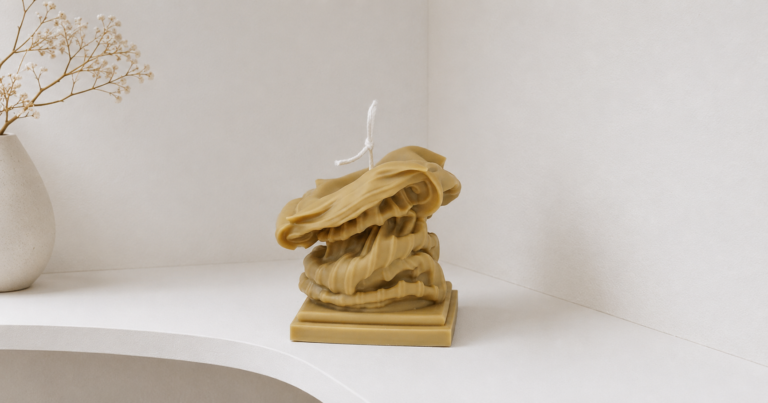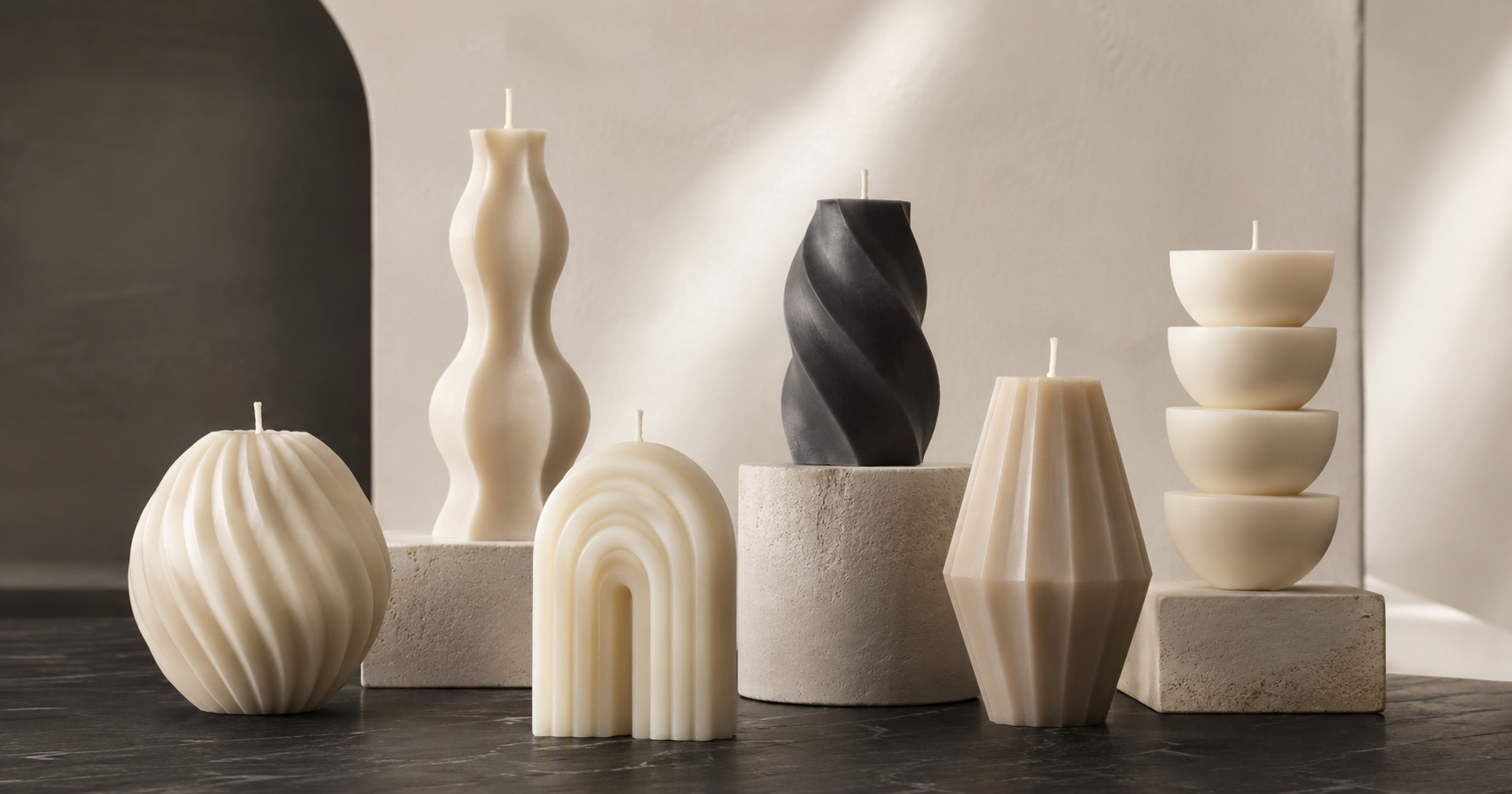

Many brands try to make a candle feel premium by choosing better wax, stronger fragrance, or more expensive packaging. That approach often misses the product itself.
A premium sculptural candle combines intentional form, controlled surface and color, suitable wax behavior, stable fragrance and burn performance, long-term appearance, and repeatable manufacturing. Premium comes from how well these elements support the original design, not from one expensive material.
What Makes a Sculptural Candle Premium?
| Premium factor | What buyers should look for |
|---|---|
| Form | Accurate geometry and preserved details |
| Surface | Intentional matte, satin, gloss, or texture |
| Color | Depth, consistency, and aging stability |
| Wax system | Material behavior matched to the design |
| Mold quality | Controlled seams and clean finishing |
| Performance | Stable scent and intended burn behavior |
| Production | Repeatable quality across the full order |
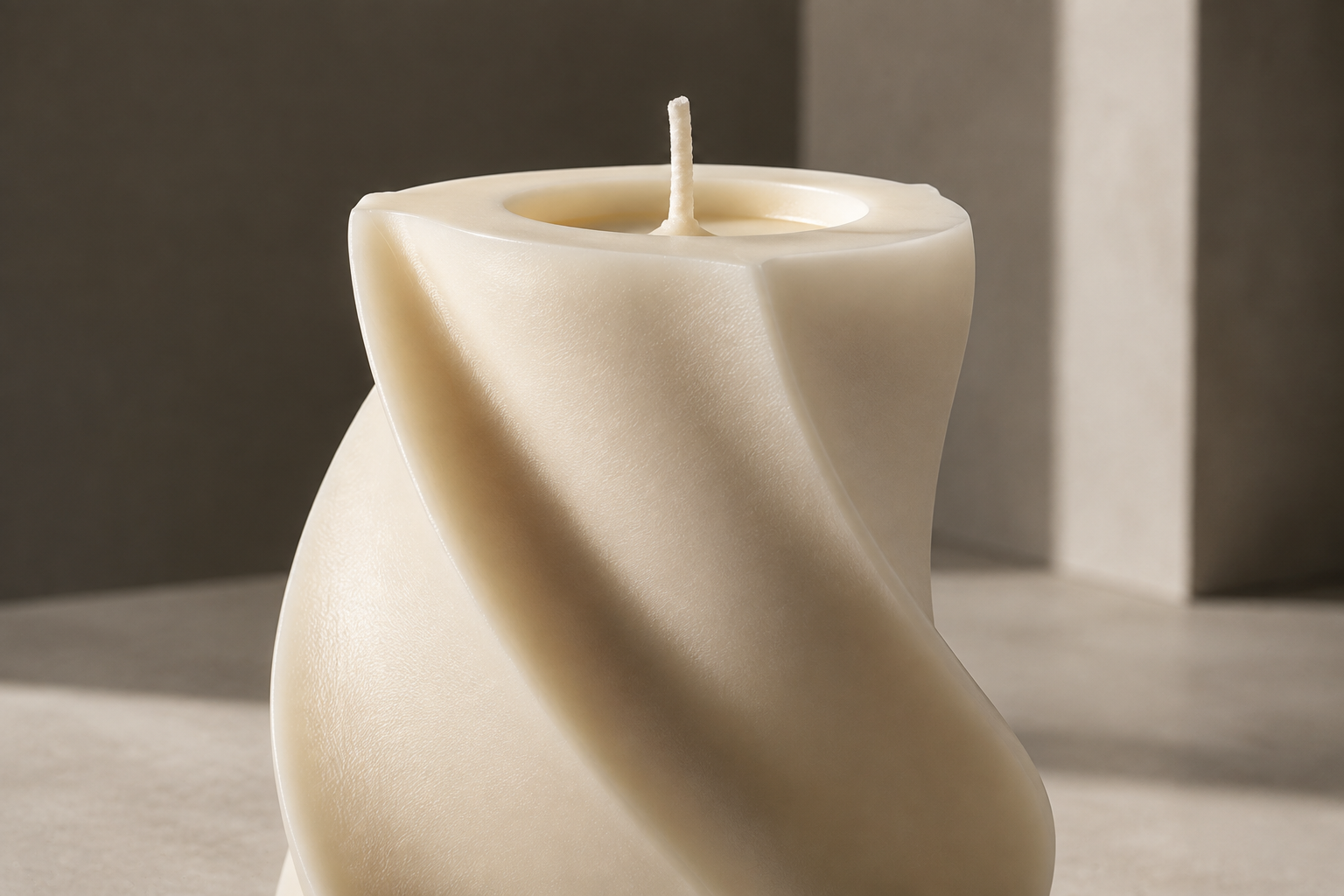
For sculptural candles, there is very little to hide behind. The wax surface is visible. The geometry is exposed. The mold lines, color, finish, and small defects all become part of the design.
This is why premium product development needs a different starting point. The first question should not be, “Which wax sounds more luxurious?” It should be, “What is this product trying to become, and what technical choices will protect that value?”
Does Premium Value Start Before Manufacturing?
A sculptural candle can carry an artist’s idea, a brand’s visual language, a cultural reference, or a design concept. Poor manufacturing can weaken all of them.
Premium value usually starts with the creator. Manufacturing does not invent that value. Its job is to translate the idea into a physical object without losing the qualities that made the concept valuable.
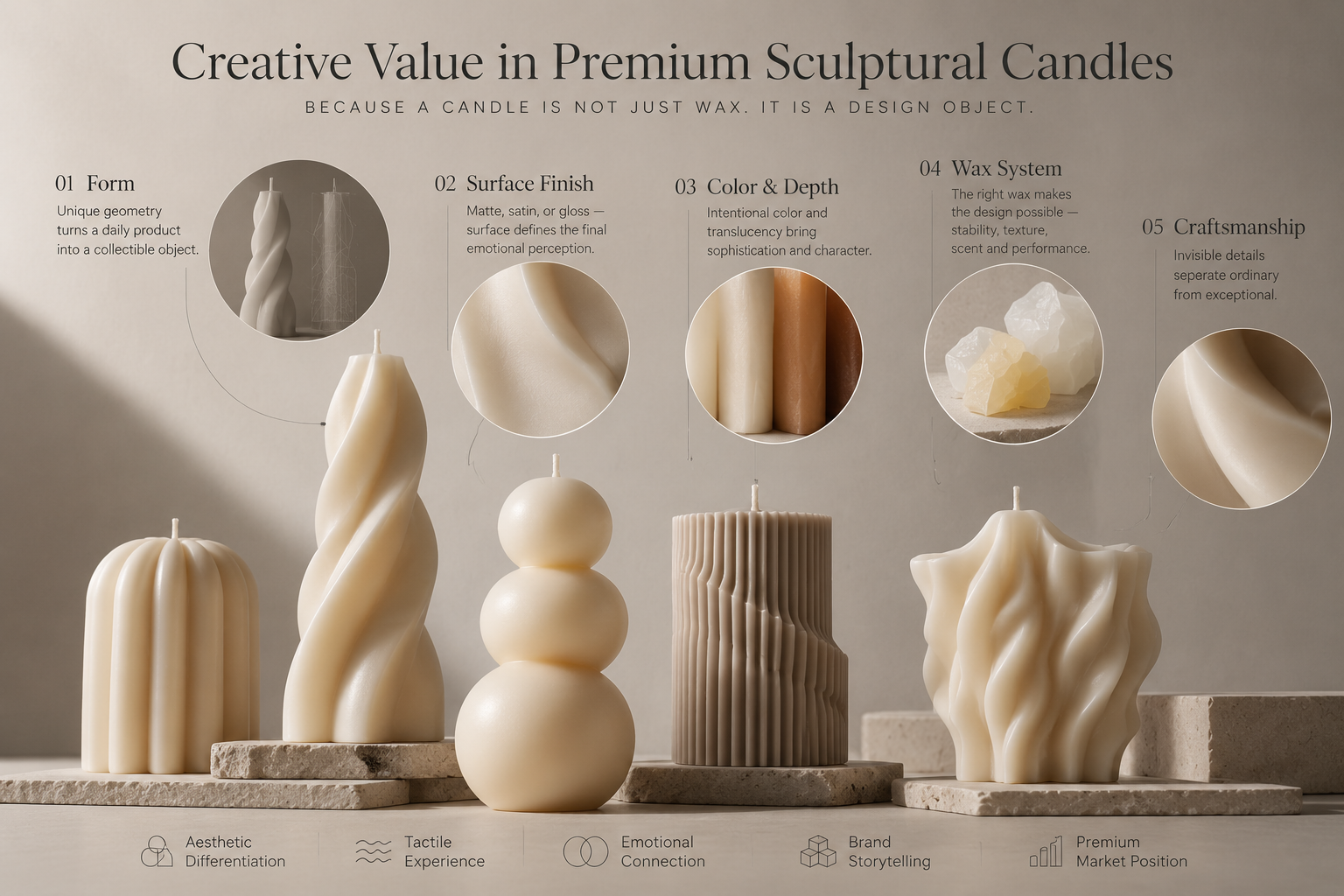
Value Can Leak During Production
A good design may begin with strong proportions, controlled curves, a specific surface, and a carefully chosen color. That design then passes through several technical stages.
The process may include 3D modeling, master development, mold making, wax formulation, pouring, cooling, demolding, finishing, packaging, and shipping.
Each stage can change the final result.
I think of this as value leakage.
A visible mold seam can interrupt an otherwise clean sculpture. A soft edge can weaken a geometric design. Frosting can change the look of a deep black candle. An oily surface can make a carefully designed object feel unfinished.
| Stage | Value that should be preserved | Common value leakage |
|---|---|---|
| Design | Form and proportion | Simplified details |
| Mold | Geometry and texture | Seams and lost edges |
| Wax | Surface and color | Frosting, dullness, distortion |
| Finishing | Clean visual result | Sanding marks, poor base |
| Production | Approved sample quality | Batch variation |
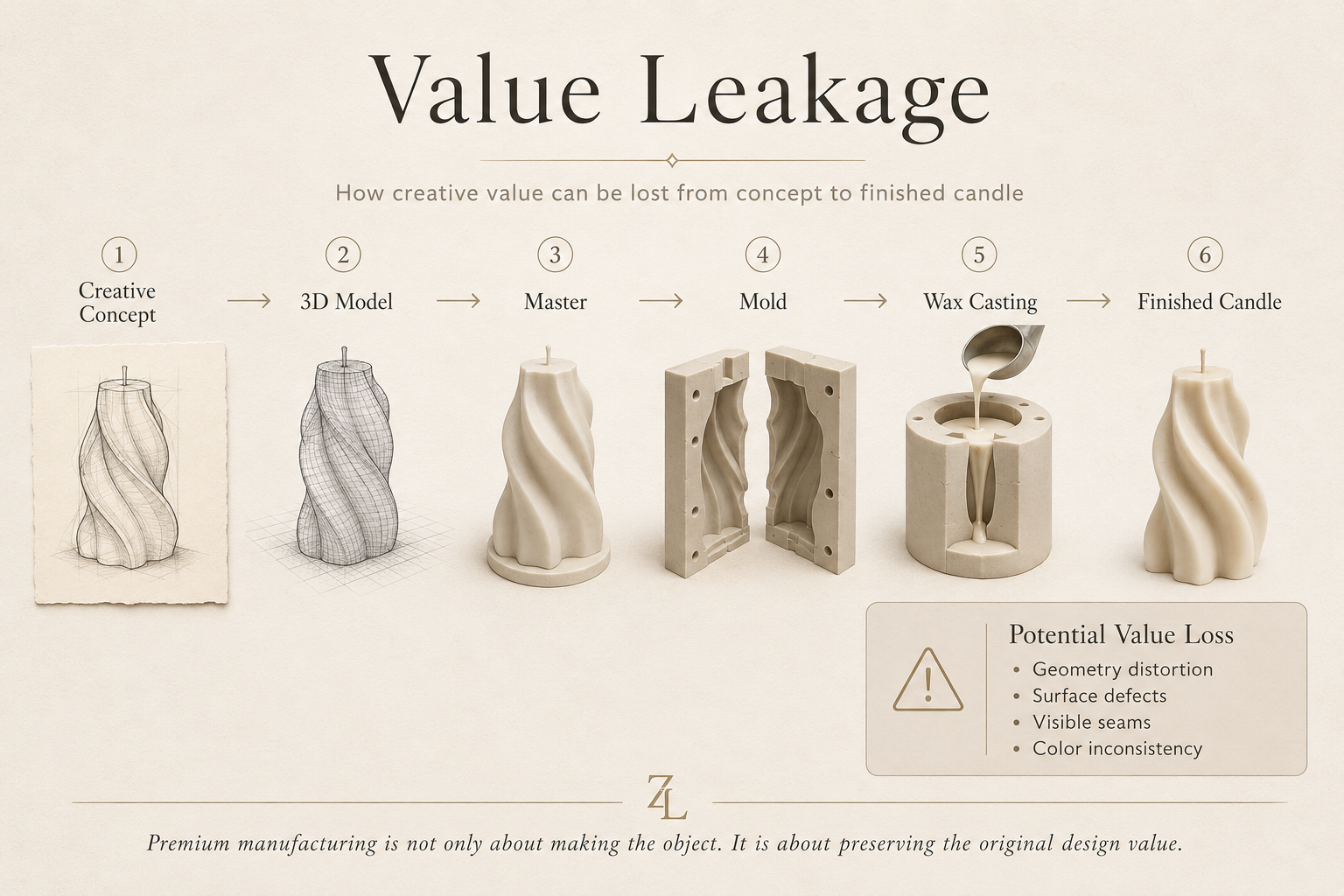
In our development work, this is why I rarely judge a project only by whether the shape can technically be produced. The more useful question is how much of the original design can survive the manufacturing process.
A premium result is not simply a successful casting. It is a successful translation of creative value into a physical product.
Is a Premium Candle About the Wax?
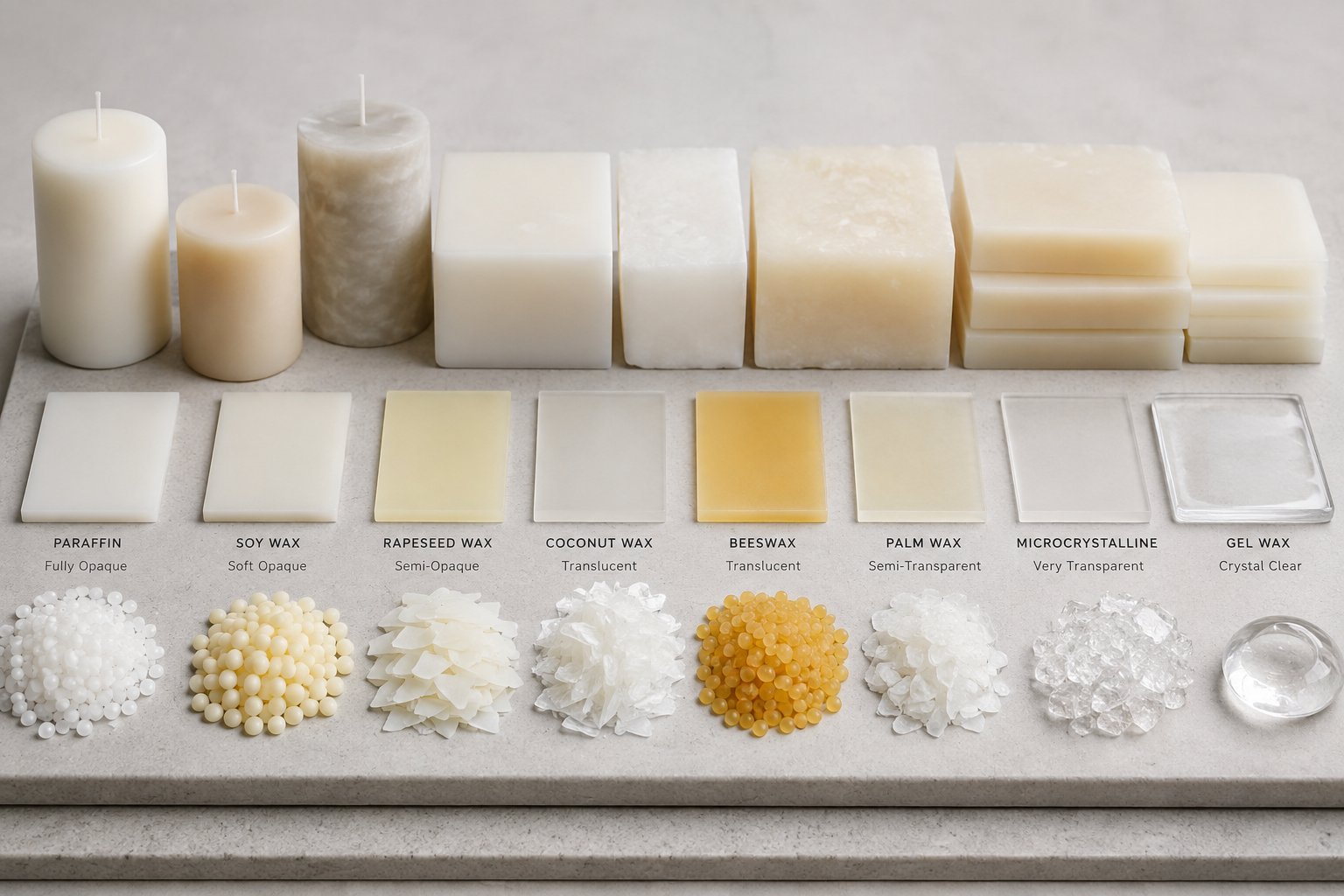
Natural wax is often presented as premium, while paraffin is often treated as low-end. That is a simple marketing hierarchy, but it is not a useful engineering rule.
Wax should be selected by behavior. Hardness, color clarity, surface quality, shrinkage, fragrance compatibility, mold release, aging, and burn performance often matter more than the material name itself.
Material Behavior Matters More Than Material Labels
Paraffin is an industrial material. That does not automatically make a paraffin candle a low-end product.
Different paraffin grades can provide useful properties for molded products. They can offer strong structure, clean color, good mold release, controlled shrinkage, and a glossy finish.
Soy wax brings a different visual character and a strong consumer story, but it can also frost. Beeswax can bring heritage, a natural scent, and a distinctive material identity, but its own color and physical behavior can limit some design directions.
There is no universal hierarchy.
| Product goal | Useful material behavior |
|---|---|
| Sharp sculptural form | Hardness and structural stability |
| Deep color | Clean base color and good dye response |
| Glossy surface | Compatible crystal structure and process |
| Natural visual language | Plant wax or beeswax character |
| Strong fragrance | Good fragrance compatibility |
| Long storage | Stable surface and oxidation control |
When we develop a custom candle, I prefer to understand the visual target and product position before recommending a wax system.
A material should be judged by what it allows the product to become, not by the marketing category attached to its name.
For a buyer, the better question is not:
“Is this soy or paraffin?”
It is:
“What material behavior does this design require?”
How Do Surface, Color, and Geometry Create Premium Perception?
A sculptural candle has very little to hide behind. A poor surface, weak color, or unresolved seam immediately becomes part of the product.
Surface, color, and geometry work together as one visual system. They should not be treated as separate cosmetic details because each one changes how the others are perceived.
Premium Does Not Always Mean Glossy
Gloss can create a strong luxury signal. It can make colors appear deeper and can make a molded object look highly finished.
But gloss is also demanding.
A glossy surface can expose scratches, fingerprints, uneven cooling, mold wear, and small differences between production units. A deliberate matte or satin surface may feel more premium when it better supports the design and can be controlled more consistently.
This changed how I think about surface development.
The real goal is not maximum gloss.
The real goal is intentional surface.
Color works in the same way. A Pantone number alone does not fully define a candle color. The same pigment can look different on a matte surface, a glossy surface, an opaque wax, or a more translucent wax.
Geometry adds another layer.
Consumers may never use terms such as parting line, draft angle, or mold fidelity. They can still notice when an object feels unfinished.
| Visible cue | What should be controlled |
|---|---|
| Surface | Intentional matte, satin, gloss, or texture |
| Color | Depth, undertone, opacity, stability |
| Seam | Low-visibility placement and clean finishing |
| Edge | Enough definition to preserve the design |
| Base | Flat, clean, and finished |
| Wick entry | Controlled and visually resolved |
For sculptural candles, the wax surface becomes the product interface. There is no glass wall between the customer and the manufacturing quality.
This makes mold design, finishing, and surface control much more important than they may appear during the early design stage.
What Makes Premium Quality Survive Time?
A candle can look excellent on the approval day and still become a poor product several months later.
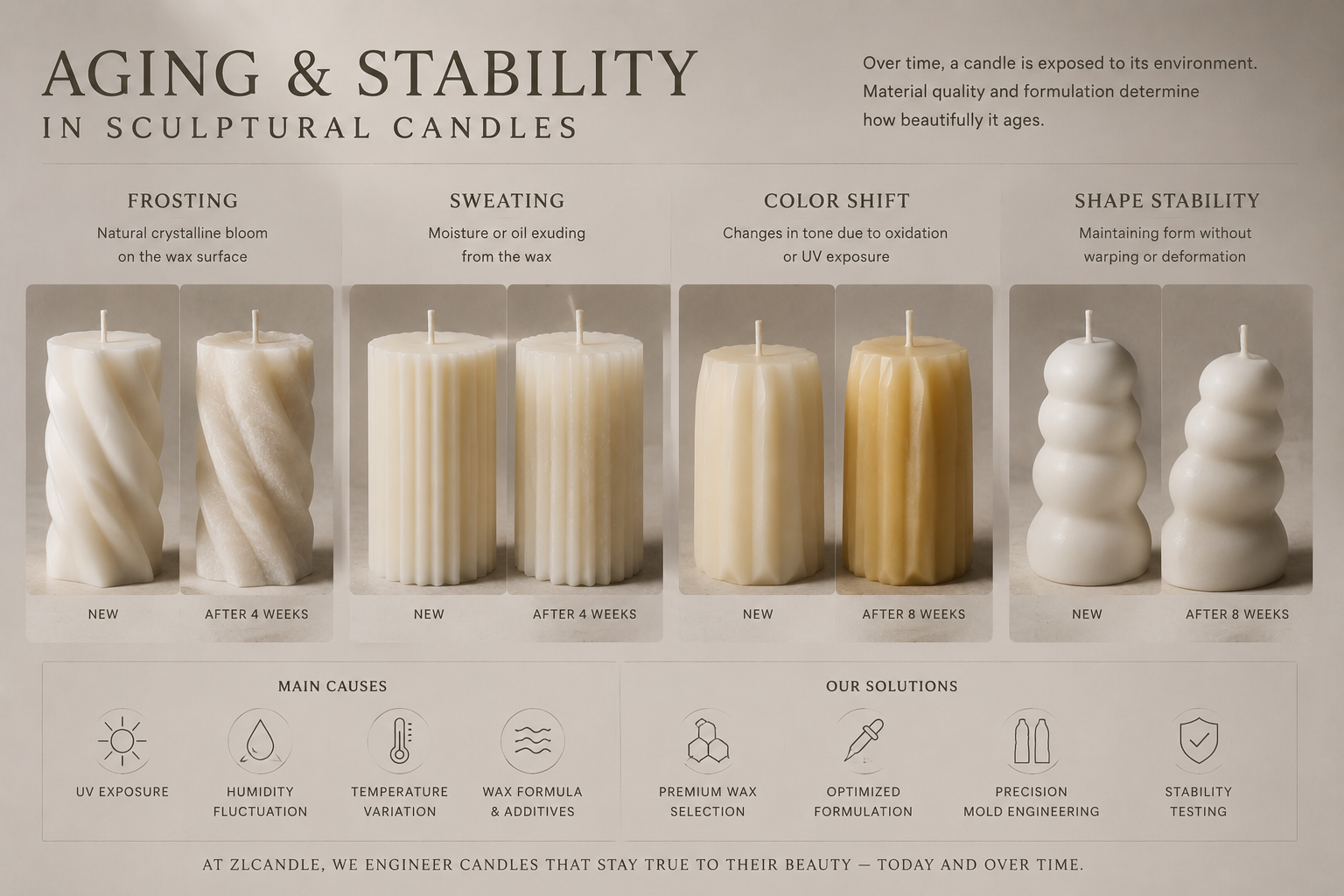
Wax is not a completely static material.1 Its structure can continue to change during storage, shipping, retail display, and use.
Shelf Life Is Part of Visual Design
Soy wax can frost.2 Beeswax can bloom.3 Fragrance oil can migrate.4 Some formulas can develop sweating. Heat can soften a shape.5 Light and oxidation can change color.6
These are technical issues, but they are also design issues.
If a product is designed as a smooth black sculpture and the surface becomes pale or crystalline after storage, the original visual concept has not really been preserved.
If a candle develops an oily surface inside the box, the customer does not care that the approval sample looked perfect several months earlier.
| Time-related risk | What should be evaluated |
|---|---|
| Frosting | Can visible crystal changes develop? |
| Sweating | Can fragrance or oil reach the surface? |
| Color change | How do heat and light affect the shade? |
| Deformation | Can shipping temperature soften the form? |
| Oxidation | Can wax or fragrance change over time? |
| Dust adhesion | Can the surface become sticky or oily? |
This leads to one of the principles I use when discussing premium product development:
Premium is not how a candle looks on the day it leaves the factory. It is how well that appearance survives time.
For that reason, shelf-life thinking should begin during formulation and sampling.
It should not begin after a complaint reaches the brand.
A premium surface that cannot survive normal storage is not really a finished premium surface.
Is More Fragrance More Premium?
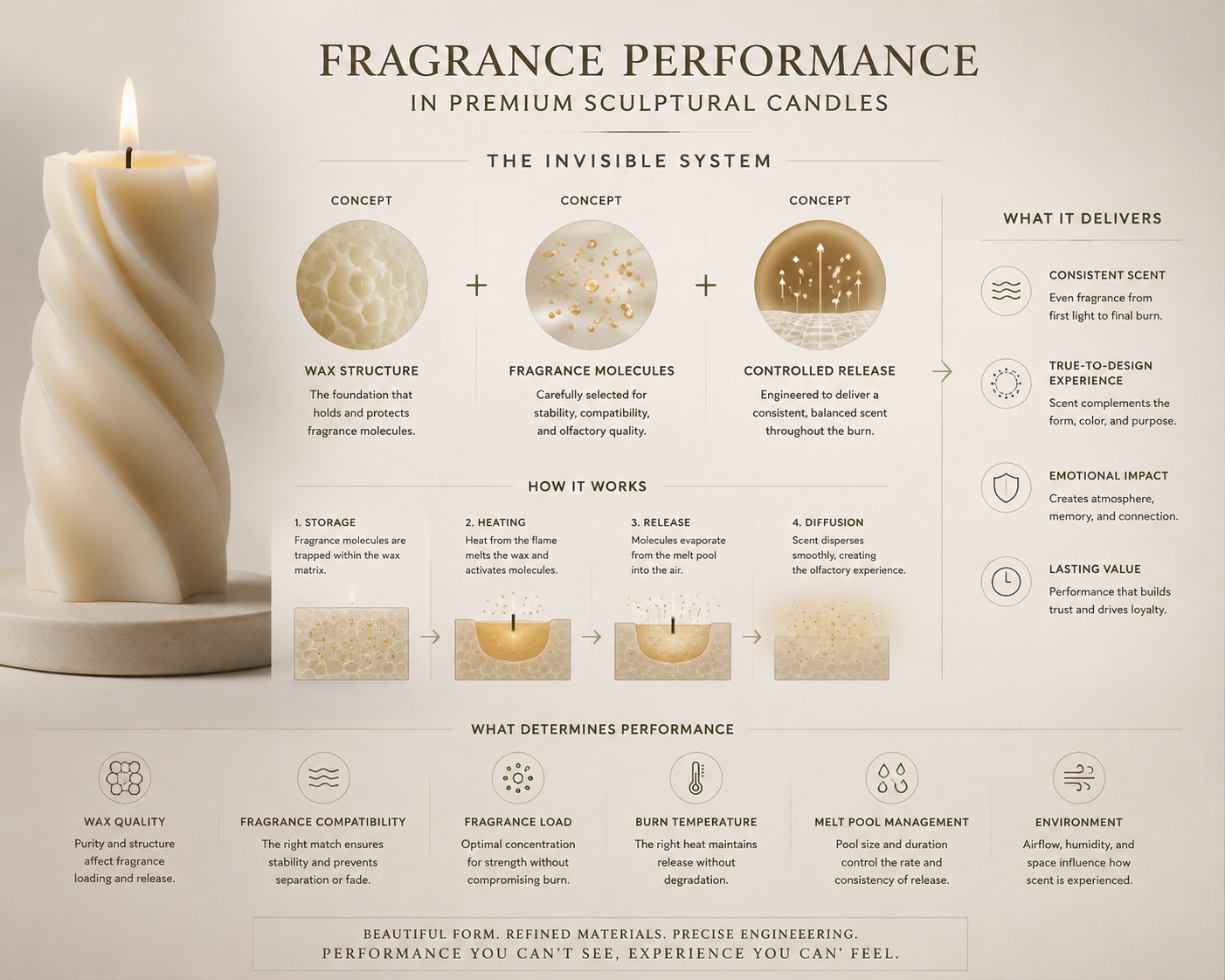
A higher fragrance percentage can sound impressive on a product specification. In practice, more fragrance does not always create a better candle.7
Fragrance performance depends on the entire system. The wax needs to hold the fragrance, release it correctly, remain visually stable, and still burn as intended.
Fragrance Should Support the Product Position
Different sculptural candles need different fragrance strategies.
A decorative object may only need a subtle cold scent. A scent-led product may need stronger hot throw. A large sculptural candle may need to balance fragrance with structural hardness and burn stability.
These goals can conflict.
Excess fragrance can lead to sweating or separation.8 It can change wick requirements.9 It can affect color. It may also fail to improve scent performance if the wax system cannot hold the additional oil correctly.
| Product position | Main development focus |
|---|---|
| Decorative object | Surface, form, low scent interference |
| Scent-led product | Cold throw, hot throw, stability |
| Burnable sculpture | Melt behavior, flame, transformation |
| Collectible wax object | Appearance and long-term stability |
| Refillable object | Durable structure and controlled wax system |
This is why our fragrance discussions usually start with product positioning rather than maximum fragrance load.
More fragrance is not more premium.
Controlled fragrance delivery is.
Burn behavior also needs a clear product decision.
Some sculptural candles are mainly decorative. Some are expected to burn beautifully. Some are closer to collectible objects.
A buyer should decide this early.
The question is not only:
“Can this candle burn?”
The better question is:
“What should this object become after it is lit?”
Why Is a Beautiful Sample Not Enough?
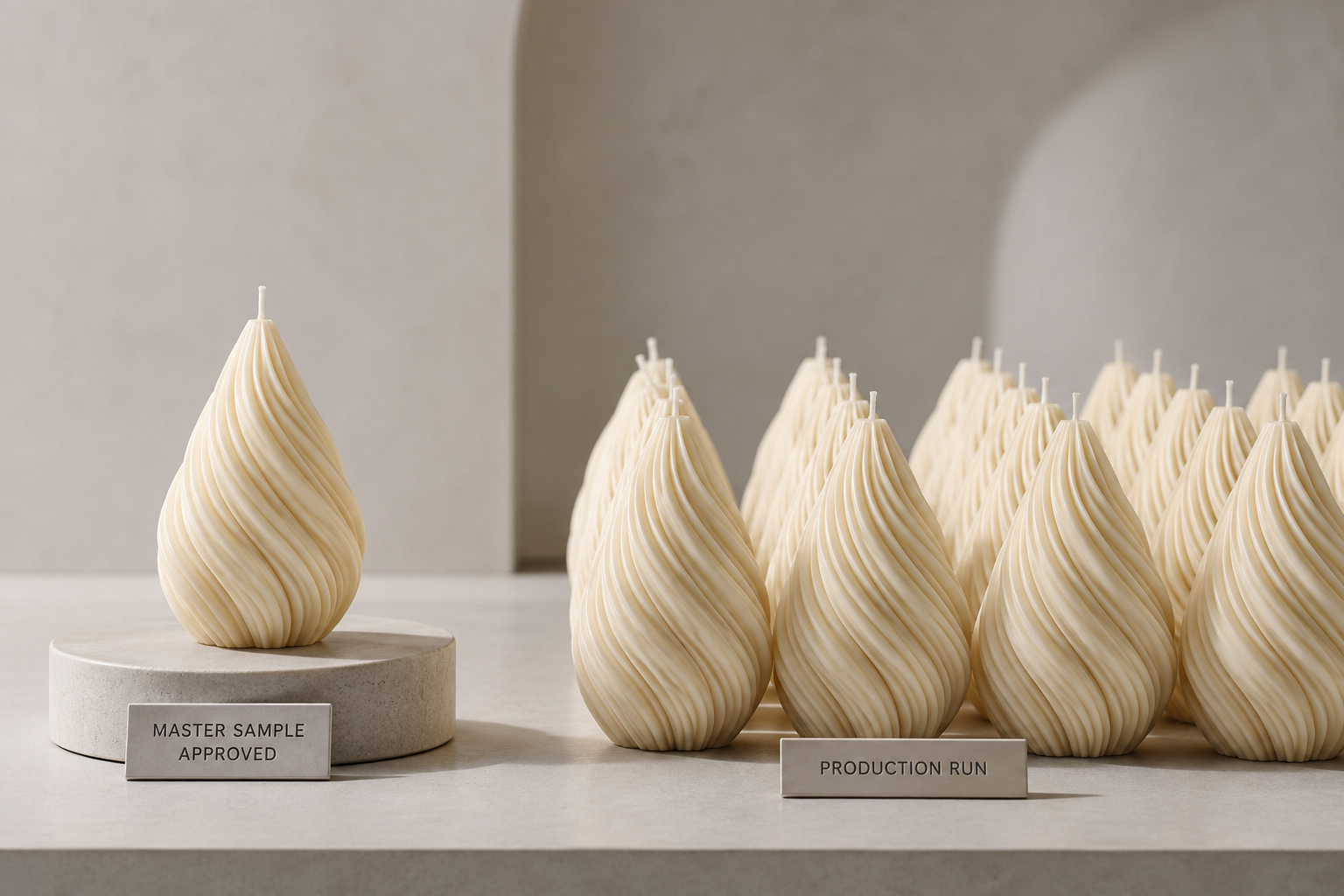
One excellent sample proves that a supplier can make one excellent candle.
It does not prove that the supplier can manufacture the same level of quality repeatedly.
Premium manufacturing starts when the approved finish, geometry, color, fragrance, and burn behavior need to survive a full production run.
Prototype Quality and Production Quality Are Different Problems
Production introduces variables that may not appear during early sampling.
Molds wear.10 Wax lots change. Fragrance lots change. Pour temperature moves. Ambient temperature changes. Cooling conditions change.11 Manual finishing introduces human variation.
This is why an approved sample should become more than a photograph.
It should become a physical production reference.
| Production control | Purpose |
|---|---|
| Golden sample | Defines the approved physical standard |
| Color tolerance | Controls visible batch drift |
| Finish standard | Defines matte, satin, gloss, or texture |
| Mold review | Detects detail loss and wear |
| Batch sampling | Checks variation across production |
| Burn testing | Confirms production units still perform |
| Aging check | Confirms the approved look can survive |
There is also an important difference between designed variation and uncontrolled variation.
Handmade products do not need to look mechanically identical. Small differences can create character. Some premium brands even use those differences as proof of craft.
But the variation still needs a boundary.
A slightly different handmade texture can feel authentic.
One candle being matte while another develops an accidental glossy patch is process inconsistency.
I use a simple distinction:
Designed variation can create character. Uncontrolled variation creates defects.
For a buyer, the goal should not be to demand impossible perfection. The goal should be to define which differences are acceptable and which differences damage the intended product.
Where Should a Buyer Spend More on a Premium Candle?
A buyer can spend more on almost every part of a candle.
That does not mean every extra dollar creates more perceived value.
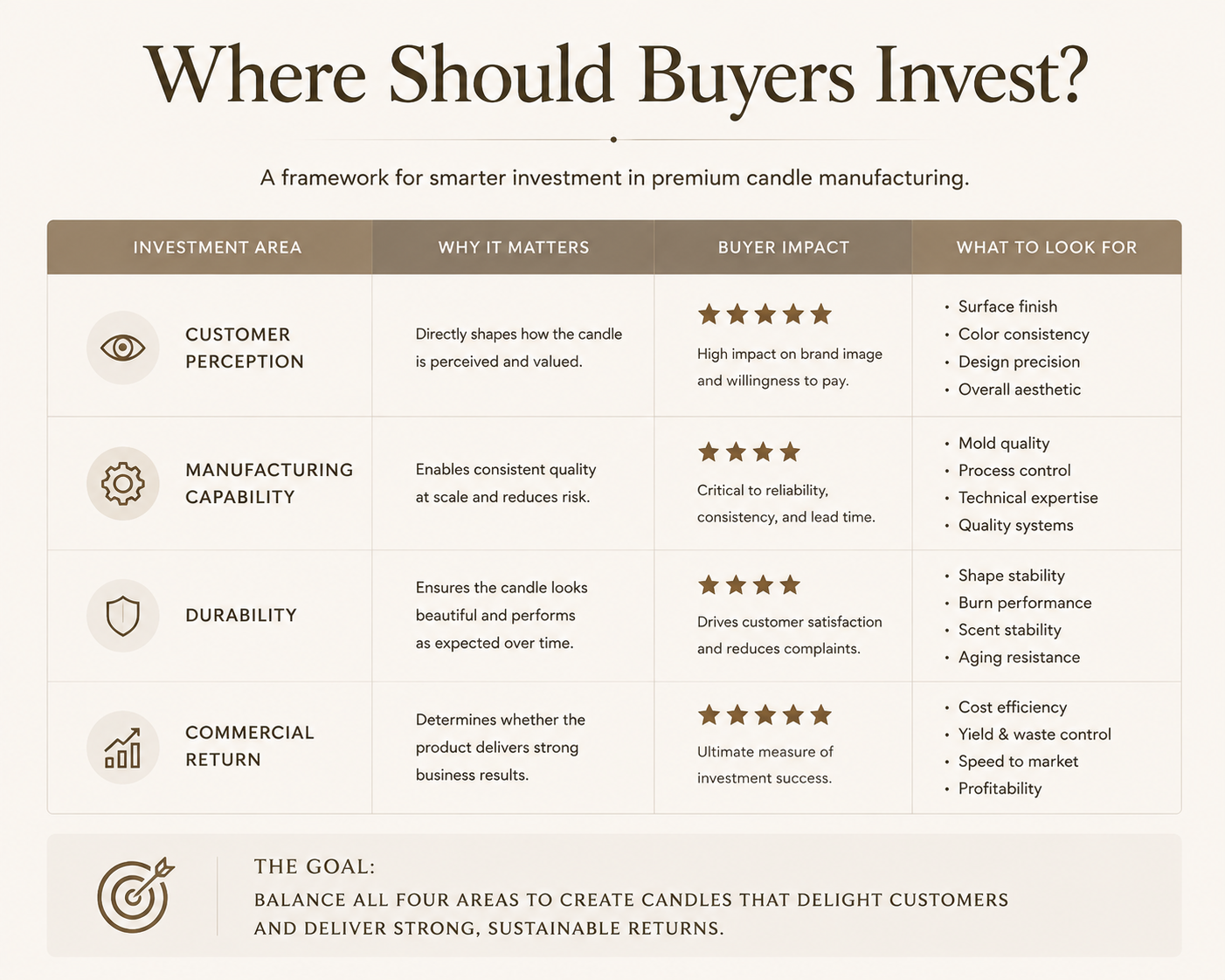
The better approach is to invest where manufacturing improves something the customer can perceive, protects the original design, lowers failure risk, and still leaves enough margin for the business.
Start With the Product Strategy, Not the Technical Specification
Before choosing materials or manufacturing levels, I usually want to understand the target retail price, customer, sales channel, expected volume, and product role.
This information changes technical decisions.
The next step is to identify the hero attribute.
If form is the hero attribute, more investment may belong in mold engineering, seam placement, geometry, surface, and finishing.
If color is the hero attribute, the priorities may shift toward wax clarity, pigment development, surface control, and aging stability.
If scent is the hero attribute, fragrance compatibility, fragrance delivery, and burn testing may become more important.
I use five questions to test whether an upgrade is worth the added cost.
| Decision test | Question |
|---|---|
| Cue Test | Can the customer actually perceive the improvement? |
| Capability Test | Can the factory repeat it in normal production? |
| Defect-Elimination Test | Does it prevent a defect or only inspect it later? |
| Durability Test | Will it survive shipping, storage, and use? |
| Margin Test | Does the product still leave enough room for profit? |
The defect-elimination question is especially important.
Moving a mold seam to a less visible area during mold development may add little recurring cost.
Producing thousands of candles with a visible seam and then sanding each one adds labor to every unit.
This is a pattern I see often in custom development:
Money spent after demolding often fixes defects. Money spent before tooling can prevent them.
This is also why I ask clients about product positioning and target selling price.
The purpose is not to discover how much the brand can afford to spend.
The purpose is to understand what level of engineering makes commercial sense.
Technical perfection and commercial optimization are not always the same thing.
A USD 40 product and a USD 150 product may not need the same tolerance, finishing time, mold structure, aging program, or inspection method.
The best manufacturing solution is not the most expensive one.
It is the solution that protects the intended product value, can be repeated reliably, and still allows the brand to make money.
Conclusion
A premium sculptural candle turns creative value into a physical object through the right materials, visible execution, controlled performance, repeatable production, and commercially sensible engineering.
"Paraffin Coated with Diatomite as a Phase Change Material (PCM) in ...", https://pmc.ncbi.nlm.nih.gov/articles/PMC12654165/. Candle waxes are semicrystalline materials whose crystal morphology and surface appearance can continue to evolve after solidification, particularly under changing storage conditions. Evidence role: mechanism; source type: paper. Supports: Wax is not a completely static material; its structure can change during storage and use.. Scope note: The rate and visible extent of change depend on wax composition, additives, temperature history, and time. ↩
"Whipped Candle Wax Tutorial | Perfect Candle Frosting for ...", https://www.youtube.com/watch?v=z9QJaXIp9Qw. Research on soy-based candle waxes describes frosting as a visible surface-crystal phenomenon associated with crystallization and thermal history in vegetable-wax systems. Evidence role: mechanism; source type: paper. Supports: Soy wax can develop frosting during storage or after manufacture.. Scope note: Frosting severity varies substantially with formulation, dye, additives, cooling conditions, and storage temperature. ↩
"'Wax bloom' on beeswax cultural heritage objects", https://pubmed.ncbi.nlm.nih.gov/25916904/. Technical and conservation literature describes beeswax bloom as a whitish surface deposit linked to migration and recrystallization of wax constituents. Evidence role: mechanism; source type: research. Supports: Beeswax can develop bloom on its surface over time.. Scope note: Terminology and mechanisms can vary across beeswax objects, coatings, and candle formulations. ↩
"Fragrance Oils for Candle Making: The Ultimate UK Guide ...", https://www.freshskin.co.uk/blog/fragrance-oils-for-candle-making-the-ultimate-uk-guide-2026/. Studies of fragrance-containing wax and polymer systems show that low-molecular-weight fragrance components may diffuse or migrate within and from a host matrix under some conditions. Evidence role: mechanism; source type: paper. Supports: Fragrance oil or its components can migrate in a wax-based candle system.. Scope note: Direct migration behavior in a finished candle depends on the fragrance composition, wax blend, loading level, and temperature. ↩
"Effect of the Addition of Different Natural Waxes on the Mechanical ...", https://pmc.ncbi.nlm.nih.gov/articles/PMC9866918/. Wax has a temperature-dependent softening and melting range; as temperature rises toward that range, its modulus and resistance to deformation decrease. Evidence role: mechanism; source type: paper. Supports: Elevated temperatures can soften a wax candle and make its shape more susceptible to deformation.. Scope note: Actual deformation during shipping depends on the wax blend, object geometry, packaging, load, and peak temperature. ↩
"A comparative study on the artificial UV and natural ageing of beeswax ...", https://pubmed.ncbi.nlm.nih.gov/31710927/. Research on wax-containing materials documents photooxidative and oxidative aging that can alter chemical composition and produce visible discoloration under light and oxygen exposure. Evidence role: mechanism; source type: paper. Supports: Light exposure and oxidation can change the color of candle materials or their components.. Scope note: The magnitude and direction of color change depend on wax type, dyes, fragrance ingredients, antioxidants, and exposure conditions. ↩
"Candle Fragrance Load Explained: How Much Oil Should You Use?", https://aromawax.eu/blogs/how-to-make-candles/candle-fragrance-load-explained-how-much-oil-should-you-use?srsltid=AfmBOoojCEkhNyX8nzopgEDKOActN4FclyYUl_bv1mmzCchKh1EfJjyi. Candle performance literature treats fragrance load as a formulation variable that must be balanced with wax compatibility, combustion behavior, and sensory release rather than maximized independently. Evidence role: general_support; source type: research. Supports: Increasing fragrance percentage does not necessarily improve overall candle quality or performance.. Scope note: “Better” includes aesthetic and commercial judgments; technical sources can support trade-offs but cannot define every brand’s preferred fragrance intensity. ↩
"Flame-Free Candles Are Not Pollution-Free: Scented Wax Melts as ... - PMC", https://pmc.ncbi.nlm.nih.gov/articles/PMC11823451/. Formulation evidence indicates that when fragrance loading exceeds a wax system’s effective compatibility or retention capacity, oil exudation and phase separation can occur. Evidence role: mechanism; source type: paper. Supports: Excess fragrance can contribute to sweating or phase separation in candle wax.. Scope note: No universal threshold applies because compatibility is specific to the wax blend, fragrance composition, additives, and temperature history. ↩
"Fate of 1 to 6 nm Candle Combustion Nanoparticles in Indoor ... - PMC - NIH", https://pmc.ncbi.nlm.nih.gov/articles/PMC12810239/. Combustion research on scented candles shows that fuel composition, including fragrance additives, can affect flame behavior, emissions, and burning characteristics, making wick selection formulation-dependent. Evidence role: mechanism; source type: paper. Supports: Fragrance additions can alter burning behavior and therefore may require different wick selection.. Scope note: The evidence supports the need for formulation-specific wick testing, not a fixed wick-size change for every fragrance addition. ↩
"Surface Treatment and Analysis of 3D-Printed Plastic Molds ...", https://pmc.ncbi.nlm.nih.gov/articles/PMC12656251/. Manufacturing research recognizes mold wear and repeated-use degradation as causes of dimensional change and reduced surface fidelity in molded parts. Evidence role: general_support; source type: paper. Supports: Repeated mold use can cause wear that affects detail reproduction or surface quality.. Scope note: The wear mechanism and service life differ between silicone, metal, and other candle-mold materials. ↩
"Design of Crystal Growth Dimensionality in Synthetic Wax", https://pmc.ncbi.nlm.nih.gov/articles/PMC10578349/. Studies of wax crystallization show that cooling rate and thermal gradients influence crystal structure, shrinkage, and resulting surface morphology. Evidence role: mechanism; source type: paper. Supports: Changes in ambient temperature and cooling conditions can affect the final structure and appearance of a wax candle.. Scope note: The exact production effect on a particular sculptural candle must be validated for its wax blend, mold, geometry, and process parameters. ↩