
A truly dripless taper candle is not created by one special wax. It results from balancing the wax system, wick, candle geometry, manufacturing process, and intended burn environment.
When these elements work together, the melt pool stays close to the flame and the wick consumes liquid wax at a controlled rate. Yet no real-wax taper can be guaranteed never to drip. Drafts, a tilted holder, an oversized flame, trapped heat, or prolonged burning can disrupt even a well-designed candle.
For commercial buyers, the real question is not whether one sample burns cleanly. It is whether the manufacturer can reproduce that performance across production batches.
What Does “Dripless” Really Mean?
“Dripless” is a practical performance description, not an absolute promise. There is no ASTM standard that creates a certified dripless category; the candle standards summarized by the National Candle Association cover areas such as fire-safety labeling, flame height, stability, and accessories—not a universal dripping threshold.
In practice, a dripless or drip-resistant taper is engineered to:
- melt wax mainly around the wick;
- maintain a small, contained melt pool;
- consume melted wax before it overflows; and
- retain a firm outer wall during normal burning.
A credible claim is therefore “engineered for low-drip performance when burned upright, in a properly fitted holder, away from drafts and excess heat”—not “guaranteed never to drip.”
Buyers should also distinguish between related claims:
| Claim | What it describes |
|---|---|
| Dripless, low-drip, or drip-resistant | Control of melted wax and runoff |
| Smokeless or low-soot | Visible smoke and soot behavior |
| Self-fitting | Compatibility between the candle base and holder |
| Clean-burning | A broad combustion claim that needs defined test criteria |
What Actually Makes a Taper Candle Dripless?
A taper burns through a heat-and-fuel cycle: the flame melts wax, the wick draws liquid fuel upward, and the vaporized fuel burns1. Dripping begins when melted wax exceeds what the wick and candle structure can contain and consume.
Five factors control that balance.
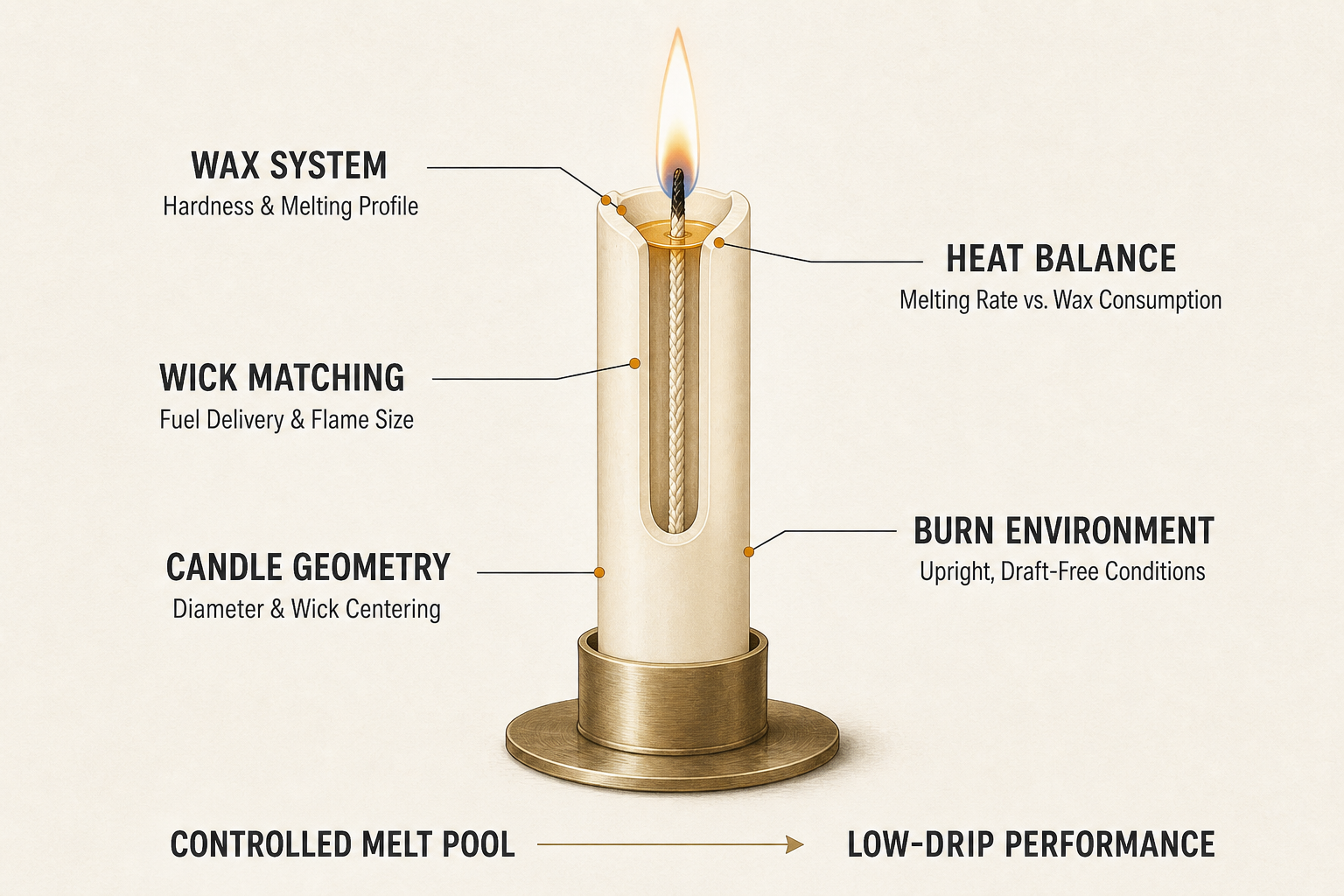
Wax system
Buyers should evaluate the complete system—not only whether a candle uses paraffin, palm, beeswax, or a plant-based material. Wax grade, blend, hardness, melting profile, additives, and colorants all affect performance.
Harder, higher-melting formulations can help retain the outer wall2, but they must still work with the wick, diameter, production method, and target burn time.
Wick matching
The wick regulates fuel delivery. An oversized wick can create a large flame and melt wax faster than it is consumed. An undersized wick can produce a weak or unstable burn.
The wick must be matched to the wax system, candle diameter, pigments or additives, and required burn behavior. A premium wax with the wrong wick can still drip.
Candle geometry
Diameter, taper angle, wall thickness, base fit, and wick position affect heat distribution. An off-center wick heats one side more aggressively, while a leaning candle directs the melt pool toward one edge3.
Heat balance
A drip-resistant taper is a small heat-management system. The flame must generate enough heat to sustain combustion without producing more liquid wax than the candle can contain and consume.
Burn environment
Even a well-engineered candle may drip because of:
- drafts from doors, windows, fans, or air-conditioning;
- a tilted candle or loose holder;
- an untrimmed or bent wick;
- trapped heat or high room temperature; or
- unusually long burn sessions.
The National Candle Association recommends trimming the wick to about 1/4 inch and keeping candles away from drafts and air currents (NCA safety guidance). Proper use supports low-drip performance, but it cannot correct a poorly engineered candle.
Why Most “Dripless” Claims Are Misleading
Many suppliers present dripless performance as a fixed property of palm wax, beeswax, stearin, or another ingredient. This is easy to market but technically incomplete.
A material can improve hardness or melting behavior, but it cannot correct an oversized wick, off-center flame, unsuitable diameter, inconsistent cooling process, tilted holder, or drafty room. A wax name describes one input; it does not prove finished-candle performance.
Industry Insight
Dripless is not a material property. It is a system property. Reliable performance comes from understanding how wax systems, wick selection, candle geometry, manufacturing processes, and real-world burn conditions interact—not from relying on one “dripless” ingredient. This requires deep knowledge of both individual materials and how they behave together throughout production and burning.
A credible supplier should be able to explain the mechanism behind its claim and the conditions under which the candle was tested.
Why Wax Alone Does Not Make a Candle Dripless
Different wax systems provide different starting properties, but none removes the need for system-level engineering.
| Wax system | Potential advantages | Important considerations |
|---|---|---|
| High-melt-point paraffin | Scalable with strong color performance | Grade, formulation, and hardening still matter |
| Paraffin-stearin blend | Good hardness and structural stability | Blend ratio and wick require validation |
| Palm wax | Naturally hard with a crystalline appearance | Cooling affects crystallization; sourcing may matter |
| Beeswax | Good stability and established taper use | Higher cost and limitations in exact color matching |
| Plant-based blends | Supports paraffin-free product briefs | Softer materials may need purpose-built blending |
| Proprietary blends | Can be tuned for a target application | The blend name needs finished-product test evidence |
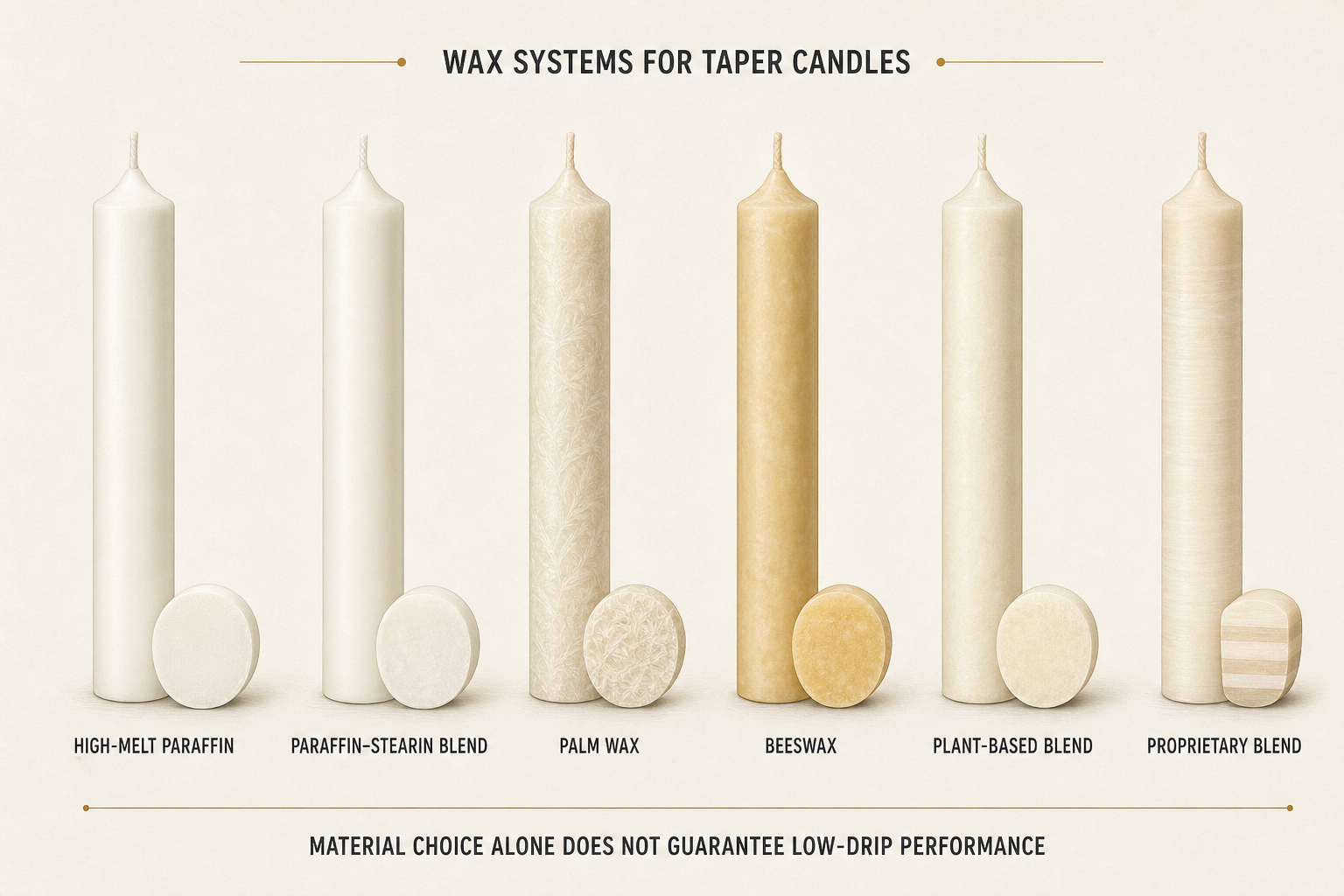
Two candles labeled with the same wax type can behave differently because they use different grades, blends, wicks, diameters, cooling profiles, or test conditions.
Why a Perfect Sample Does Not Guarantee a Successful Production Run
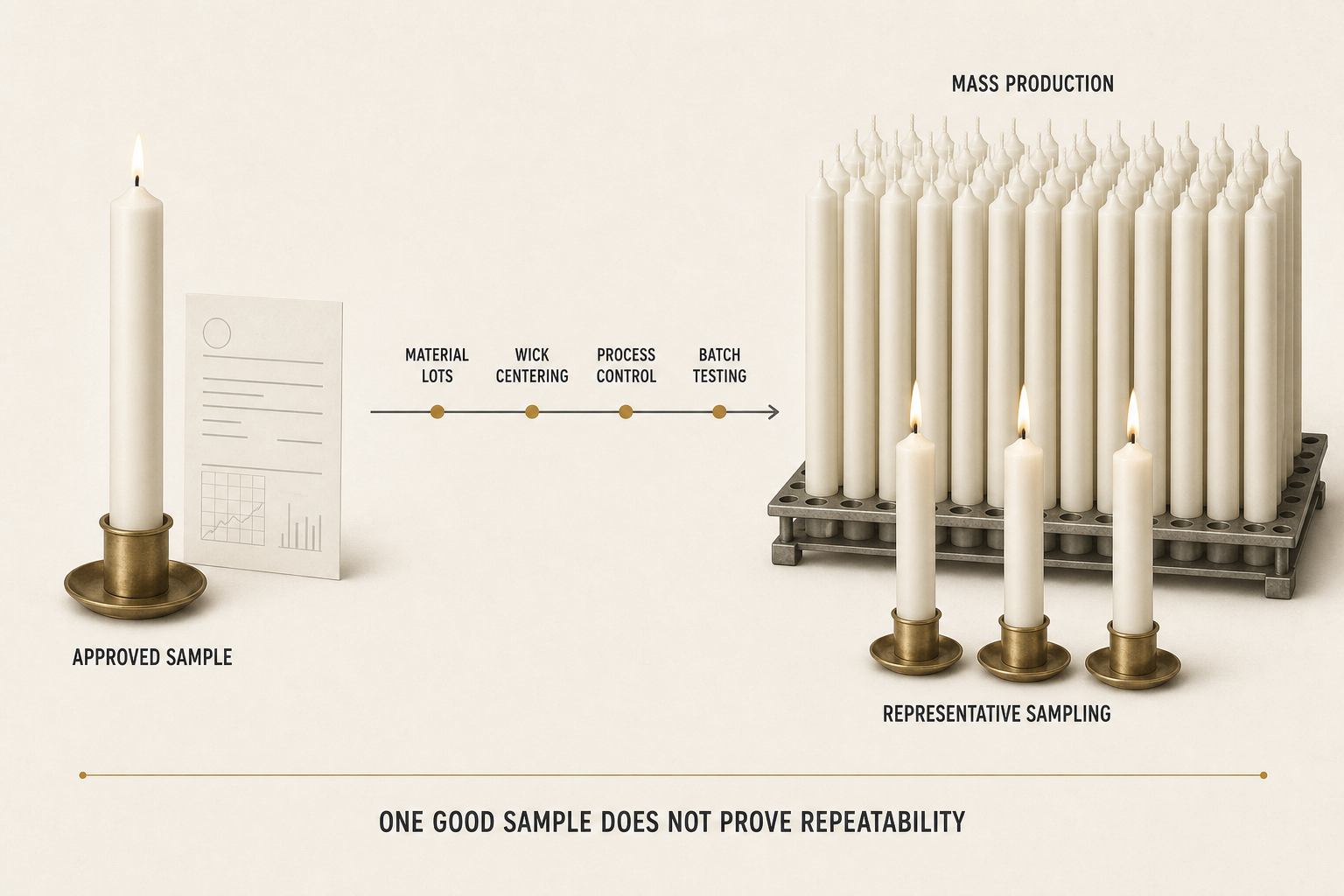
A development sample shows that one candle can meet the target under one set of conditions. A commercial order asks whether the result can be reproduced across thousands of candles and future reorders.
Performance may change between sample approval and production because of variation in:4
- raw-material lots or blend ratios;
- wick specification, tension, or position;
- heating and processing temperatures;
- dipping, forming, or cooling conditions;
- candle diameter and straightness; or
- pigments and other additives.
A perfect sample can therefore hide a weak production-control system. Sample approval should establish a controlled reference covering materials, wick, dimensions, test conditions, and acceptance criteria.
The real question is not “Can this sample burn without dripping?” but “Can this supplier reproduce the same performance at scale?”
Why Commercial Buyers Should Evaluate Consistency
A consumer experiences one candle. A commercial buyer may use the same product across hundreds of tables, venues, events, or retail packs. At that scale, even a small failure rate can lead to damaged linens, cleaning work, replacements, returns, and complaints.
Buyers should evaluate three levels of performance:
- Product performance: Does the candle meet the target under defined conditions?
- Batch consistency: Do samples from the production batch perform comparably?
- Reorder repeatability: Can later batches reproduce the approved specification?
Buyer Insight
Commercial buyers do not buy a dripless sample. They buy the manufacturer’s ability to reproduce low-drip performance at production scale.
Why Production Consistency Determines Long-Term Performance
Production control keeps the variables that affect burning within an acceptable range:
- Raw materials: Control the wax grade, blend, additives, colorants, and incoming lots.
- Process: Maintain stable heating, mixing, forming or dipping, and cooling parameters.
- Wick and geometry: Control wick identity and position, diameter, straightness, and base fit.
- Inspection: Check for cracks, bending, color variation, and surface or wick-placement defects.
- Burn testing: Test representative finished candles under documented conditions.
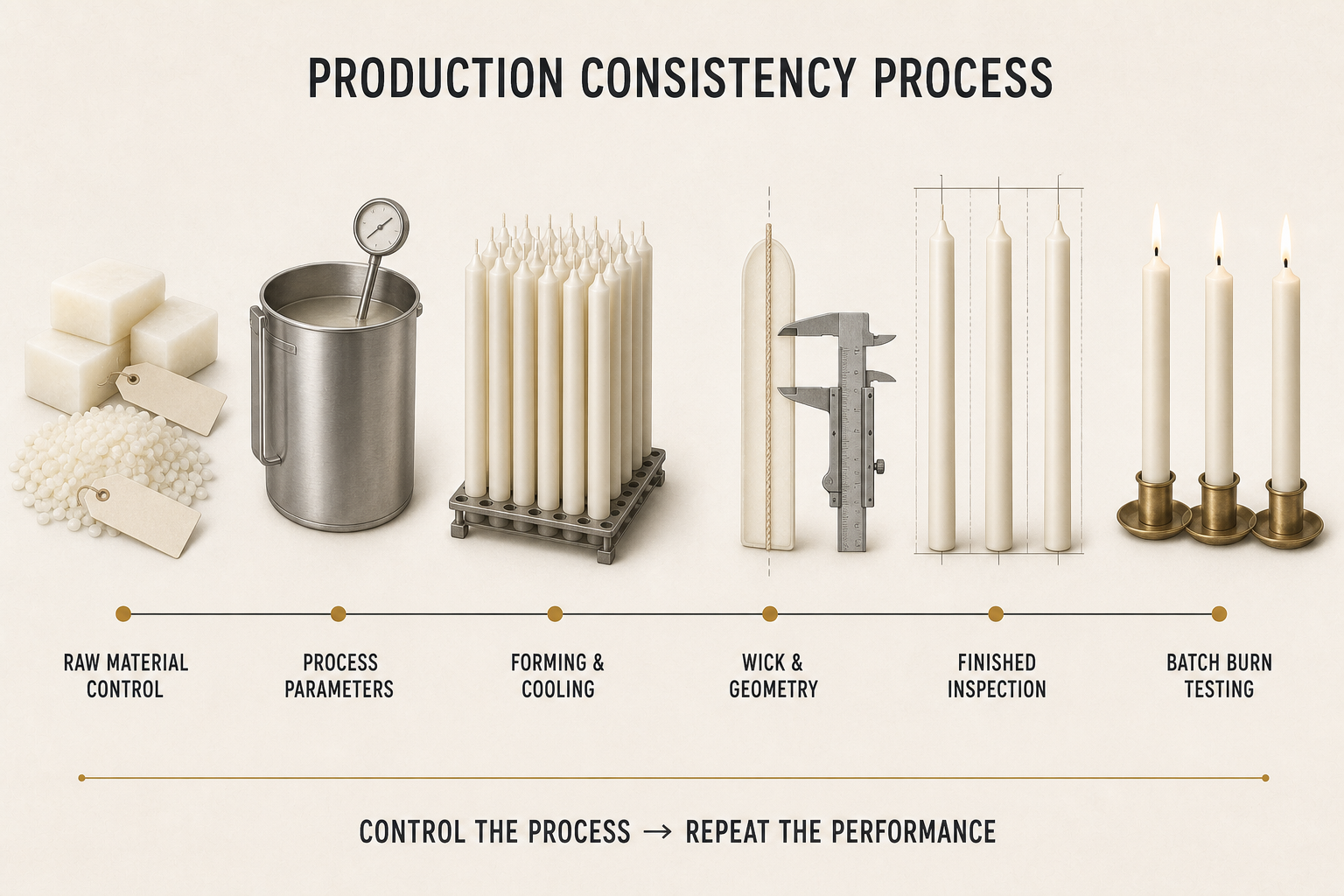
A useful burn-test record identifies the candle and holder, wick preparation, room conditions, airflow, burn duration, sample-selection method, and observed wax runoff. Eurofins includes flame height, burn time, and dripping behavior among the observations used in candle evaluation.
Testing only a specially prepared development sample does not demonstrate batch consistency.
How to Evaluate a Dripless Candle Manufacturer
Experienced buyers examine whether the supplier understands and controls the complete burn system.
| Procurement question | What a strong answer includes |
|---|---|
| What wax system is used, and why? | Material properties, formulation logic, and application fit |
| How was the wick selected? | Matching to wax, diameter, additives, and target burn behavior |
| What conditions define the claim? | Holder, wick length, airflow, temperature, and burn duration |
| How is the sample transferred into production? | Controlled specifications, approved references, and change control |
| How is batch consistency checked? | Defined sampling, dimensional inspection, and burn testing |
| Can you test in our holder and use environment? | Application-specific validation or a realistic simulation |
| What happens if a material or wick changes? | Requalification, approval, and buyer communication |
Before requesting samples, buyers should define the candle dimensions, holder opening, required burn duration, use environment, color and finish, packaging conditions, and acceptable wax runoff under the agreed test method.
There is no universal taper for a restaurant, wedding, church, hotel, outdoor event, and retail pack. Each application should be validated against its actual conditions.
The Dripless Consistency Framework™
Reliable Dripless Performance = Wax System × Wick Matching × Production Consistency × Application-Specific Engineering
The multiplication sign is deliberate: a serious weakness in one pillar can undermine the others.
- Wax System: Evaluate the complete material system, not one ingredient name.
- Wick Matching: Match fuel delivery to the wax, diameter, and target burn behavior.
- Production Consistency: Control materials, processes, dimensions, inspection, and batch testing.
- Application-Specific Engineering: Design backward from the holder, airflow, burn duration, appearance, and commercial risk.
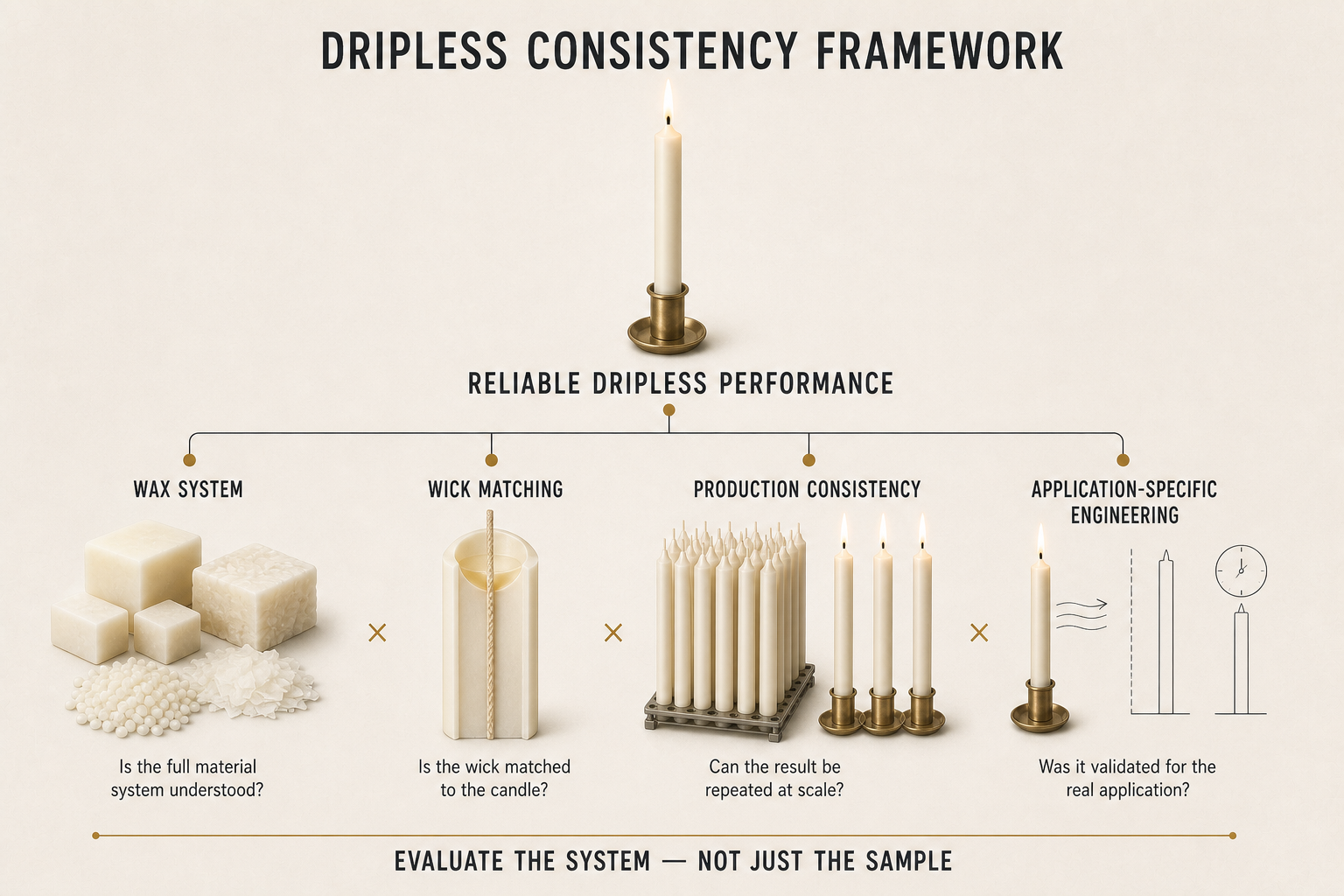
Together, these pillars turn “dripless” from a vague marketing claim into an assessable manufacturing capability.
Common Procurement Mistakes
- Choosing by wax type alone: Wax is an input, not proof of finished performance.
- Approving one sample: One test demonstrates possibility, not repeatability.
- Leaving test conditions undefined: Supplier results cannot be compared without a common protocol.
- Ignoring holder fit: A leaning candle can heat unevenly and drip.
- Using appearance as proof: Finish and straightness matter, but only a burn test evaluates burn behavior.
- Failing to control changes: Material, wick, dimension, or color changes may require revalidation.
Frequently Asked Questions
Are dripless taper candles completely drip-free?
No. A credible low-drip claim assumes the candle is upright, correctly fitted, properly maintained, and protected from drafts and excess heat.
What wax makes the most dripless candle?
No single wax guarantees the result. Hardness and melting profile matter, but wick matching, geometry, process control, and burn conditions are equally important.
Can plant-based taper candles be drip-resistant?
Yes. Palm, beeswax, and engineered plant-based blends can support drip-resistant designs. Each option requires evaluation for hardness, appearance, sourcing, color, cost, scale, and finished-candle performance.
Does wick size affect dripping?
Yes. An oversized or poorly matched wick can create a large flame and melt wax faster than it is consumed. Wick selection must be validated with the finished candle.
Why does a dripless taper still drip?
Common causes include drafts, leaning, poor holder fit, a long or bent wick, trapped heat, high temperature, extended burning, or production variation.
How should manufacturers test dripless performance?
Use a documented protocol covering the candle, holder, wick preparation, airflow, temperature, burn duration, sampling method, and wax runoff. Test representative production samples—not only development pieces.
Are dripless tapers suitable for weddings and restaurants?
Yes, when validated for the actual holder, service duration, airflow, and room conditions. Unscented versions are often preferred around food and in scent-sensitive settings.5
Can dripless taper candles be customized?
Yes, but changes to size, color, finish, fragrance, wax, or burn-time target can alter the system. Significant customization should trigger wick review and new burn validation.
Final Takeaway for Commercial Buyers
A truly dripless taper candle is not defined by a material label or one impressive sample. It depends on the controlled interaction of materials, wick, geometry, manufacturing, and the intended burn environment—and on the supplier’s ability to reproduce that interaction at scale.
The candle you approve is a sample. The candle your customer experiences is a production system.
Professional sourcing decisions should evaluate that system: how it was engineered, how it was tested, how production variation is controlled, and how closely the validation conditions match real use.
<!--[googlesitekit-end-of-content]-->
"HEAT AND MASS TRANSPORT INSIDE A CANDLE WICK", https://etd.ohiolink.edu/acprod/odb_etd/ws/send_file/send?accession=case1157564736&disposition=inline. Candle-combustion studies describe the flame-driven melting of wax, capillary transport of liquid fuel through the wick, vaporization near the flame, and combustion of the wax vapor. Evidence role: mechanism; source type: paper. Supports: A taper burns through a cycle in which the flame melts wax, the wick draws liquid wax upward, and vaporized fuel burns.. ↩
"Is dripping candle wax on genitals safe? | Go Ask Alice!", https://goaskalice.columbia.edu/answered-questions/dripping-candle-wax-genitals-safe. Materials references on waxes report that melting range and hardness influence thermal softening and structural rigidity, properties relevant to a taper candle's ability to retain an unmelted outer wall during burning. Evidence role: mechanism; source type: research. Supports: Harder, higher-melting formulations can help retain the outer wall.. Scope note: These material properties alone do not establish low-drip performance for a specific finished candle. ↩
"Open-Flame Decorative Devices | Fire and Rescue", https://www.fairfaxcounty.gov/fire-ems/fire-marshal/open-flame-decorative-devices. Fire-safety guidance advises keeping candles upright in suitable holders, consistent with the principle that tilting changes the orientation of molten wax and can promote runoff at one side. Evidence role: general_support; source type: government. Supports: A leaning candle directs the melt pool toward one edge.. Scope note: Safety guidance supports the practical risk of an improperly positioned candle but does not quantify runoff for every taper design. ↩
"Manufacturing and Quality | www.waru.edu", https://www.waru.edu/tools/dau-systems-engineering-brainbook/design-considerations/manufacturing-quality. Manufacturing-quality literature establishes that variation in incoming materials, process parameters, and product dimensions can change finished-product characteristics; for candles, these variables are relevant to burn behavior and conformance. Evidence role: general_support; source type: institution. Supports: Variation in materials, wick placement, processing, cooling, dimensions, pigments, and additives can cause production candles to perform differently from an approved sample.. Scope note: The source should support the quality-control principle; direct evidence is still needed to quantify the effect of each variable on a given candle design. ↩
"U.S. Access Board - Fragrance-Free Environment", https://www.access-board.gov/about/policy/ffe.html. Guidance for fragrance-sensitive environments and food-service settings commonly recommends minimizing added fragrances to reduce odor interference and accommodate people with fragrance sensitivities. Evidence role: expert_consensus; source type: government. Supports: Unscented candles are often preferred around food and in scent-sensitive settings.. Scope note: Preference varies by venue, customer population, local policy, and the specific food-service context. ↩